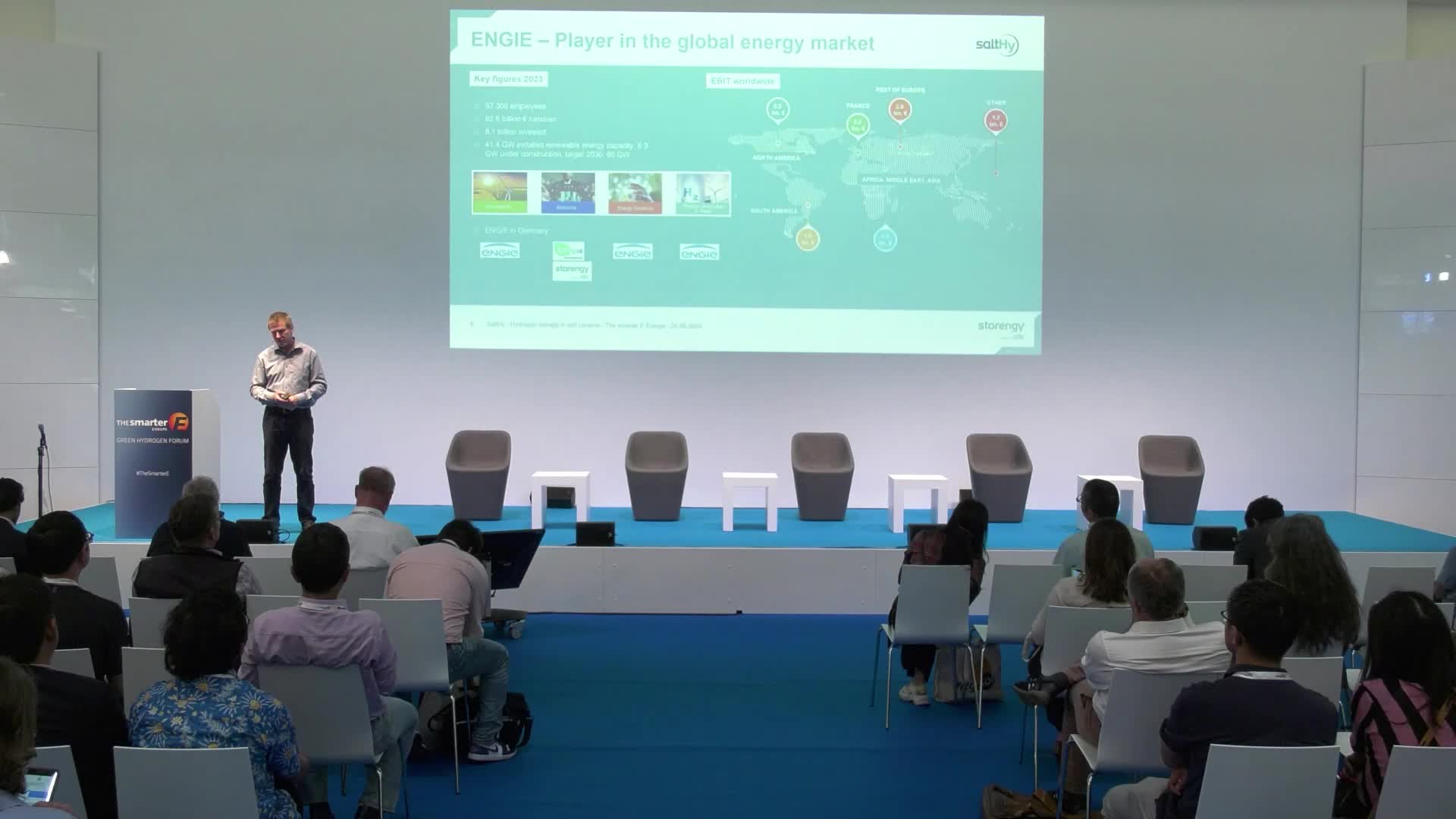
Underground Hydrogen Storage in Salt Caverns

Premium Account

Recording of Thursday, June 20, 2024 | The smarter E Europe 2024 | Exhibition Program | Language: English | Duration: 21:09 .

StorEnergy Presents Underground Hydrogen Storage in Northern Germany to Decarbonize Heavy Industries

Gunnar Assmann from StorEnergy presented on underground hydrogen storage in salt caverns, emphasizing the transition from natural gas to hydrogen. StorEnergy is a major French-based energy company involved in electricity, gas, and networks with plans to significantly increase renewable electricity generation by 2030. The project focuses on Haasefeld near Hamburg, part of their six German underground storage locations. Historical salt deposits from the ancient Zechstein Sea make Northern Germany ideal for such storage due to its plasticity and containment properties. Gunnar Assmann detailed how these caverns are created at depths of 1000-1500 meters using boreholes and compressor units for injecting gas into them. This infrastructure has been successfully used for natural gas over decades and will now be adapted for hydrogen. He highlighted the need to replace depleting natural gas fields with hydrogen while utilizing existing pipeline infrastructures where possible. The shift aims at decarbonizing industries that cannot rely solely on electricity, particularly steel and glass manufacturing sectors rather than household heating which dominated natural gas consumption patterns traditionally marked by seasonal variations.

Automatisierte Zusammenfassung durch AI Conver

Gunnar Assmann
Projekt Lead Hydrogen Storage
Storengy Deutschland GmbH
Germany

It is foreseeable, hydrogen and its derivatives will be shipped to Europe in the years to come and prompt the path of the energy carrier. What form will play what role amongst to option on the table? It still looks like an open race.

Speaker

Olivier Bucheli
President
European Electrolyser & Fuel Cell Forum
Switzerland

To Talk

Speaker

Tobias Puklavec
CTO
Green Energy Park Global B. V.
Germany

To Talk

Speaker

Dr.-Ing. Hans-Peter Schmid
Managing Director
WS Reformer GmbH

To Talk

Speaker

Ralf Ott
Head of Policy and Regulation
Hydrogenious Lohc Technologies GmbH
Germany

To Talk

Speaker

Alexander Voigt
CEO
HH2E
Germany

To Talk

Weiterführende Inhalte
Webinar
Mixed Investment Solar Projects in Mexico: The 54% Model Explained

January 29, 2026

Mexico has introduced a new mixed investment scheme for renewable power generation, requiring a minimum 54% direct or indirect participation by CFE.

Anna Darmani, Principal Analyst from Wood Mackenzie
Big BESS Is Here to Save the Day

The smarter E Podcast Episode 246 | Language: English

January 8, 2026

Utility-scale batteries are booming in Europe. Discover key BESS trends, market impacts, and what to expect for large-scale storage in 2026.

Irene Guerra Gil, Mark Bruno
Staying Home, with Smart Energy Management

The smarter E Podcast Episode 245 | Language: English

December 11, 2025

Irene Guerra Gil and Mark Bruno explain how smart home energy systems and building initiatives cut costs and emissions.

The smarter E Europe Exhibition Program 2025
DC Microgrids as the Next Frontier in Grid Modernization and DER Integration

Wednesday, May 07, 2025, 11:00 am - 12:25 pm

The smarter E Europe Exhibition Program 2025 | Exhibition Program

Premium Account

Discover how next-gen distribution grid technologies are addressing the challenges of renewable integration and dynamic energy demands. This session offers insights into the latest developments in AI-driven data analytics and the transformative role of IoT in grid management.

The smarter E Europe Conferences 2025
Setting the Scene "Off-Grid"

Wednesday, May 07, 2025, 04:00 pm - 05:30 pm

The smarter E Europe Conferences 2025 | Conference Program

Premium Account

Photovoltaic prices have fallen continuously in recent years - a trend that should translate into a growing market for off-grid solutions. Declining costs are crucial for rural electrification in particular, making sustainable energy supply economically viable in remote regions. However, so far many of these price advantages have not yet reached the people that need them most. Do existing framework conditions to foster rural electrification still work in this new market reality? Which measures are needed to ensure that cost reductions reach our target group? This session discusses strategies for improving the availability of low-cost off-grid solutions, financing and innovative business models. A look at successful practical examples shows which political, economic and technological levers need to be pulled to make off-grid PV accessible on a large scale.

Sie verwenden einen veralteten Browser

Die Website kann in diesem Browser nicht angezeigt werden. Bitte öffnen Sie die Website in einem aktuellen Browser wie Edge, Chrome, Firefox oder Safari.