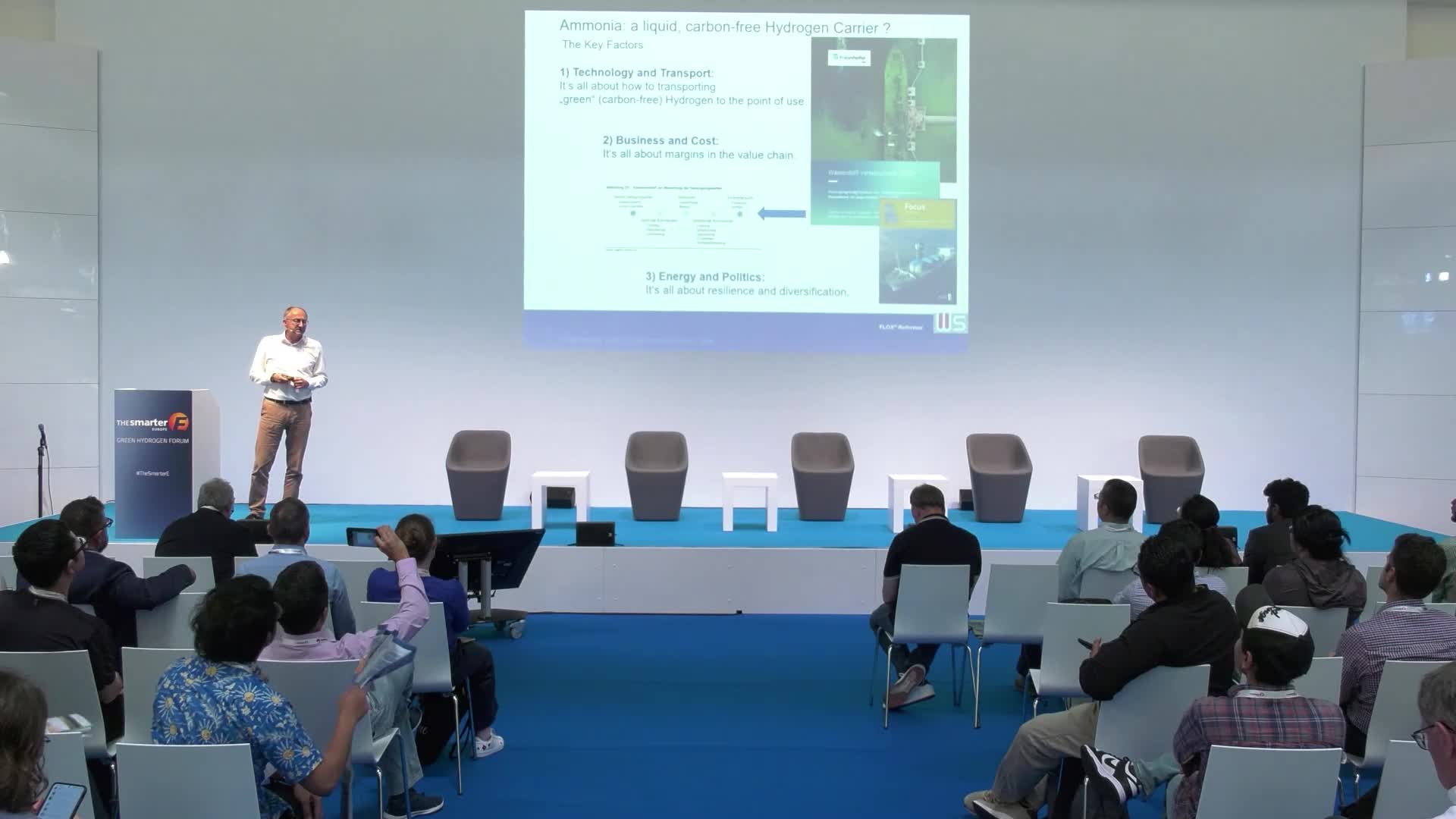
Decentralized Hydrogen to Distribution Gas Networks through Ammonia

Premium Account

Recording of Thursday, June 20, 2024 | The smarter E Europe 2024 | Exhibition Program | Language: English | Duration: 16:36 .

Decentralized Hydrogen Production and Ammonia Transport: A Vision for Europe's Energy Future

Hans-Peter Schmidt, a veteran in the hydrogen sector with over 20 years of experience at WS Reformer, elaborates on the importance of decentralized hydrogen production. He emphasizes that Europe needs to import renewable energy due to insufficient local production and highlights hydrogen as a key player in this transition. Various methods for transporting and liquefying hydrogen are discussed, including ammonia, methanol, liquefied hydrogen at low temperatures, and liquid organic carriers. Schmidt focuses particularly on using ammonia for decentralized applications. He contrasts large centralized reformer plants with smaller containerized solutions which convert ammonia into hydrogen locally. Although these small-scale operations have lower efficiency compared to large plants, they offer flexibility by cracking or converting ammonia directly at the point of use. He also discusses transportation logistics involving different vessel sizes designed for rail or road transport. These setups facilitate efficient and timely delivery of ammonia from distribution centers to end-users. Addressing potential applications such as substituting natural gas with combined heat power (CHP) systems and utilizing fuel cells is highlighted as part of his vision towards decarbonizing mobility sectors through new technologies like solid oxide fuel cells integrated with ammonia.

Automatisierte Zusammenfassung durch AI Conver

Dr.-Ing. Hans-Peter Schmid
Managing Director
WS Reformer GmbH

It is foreseeable, hydrogen and its derivatives will be shipped to Europe in the years to come and prompt the path of the energy carrier. What form will play what role amongst to option on the table? It still looks like an open race.

Speaker

Olivier Bucheli
President
European Electrolyser & Fuel Cell Forum
Switzerland

To Talk

Speaker

Tobias Puklavec
CTO
Green Energy Park Global B. V.
Germany

To Talk

Speaker

Ralf Ott
Head of Policy and Regulation
Hydrogenious Lohc Technologies GmbH
Germany

To Talk

Speaker

Gunnar Assmann
Projekt Lead Hydrogen Storage
Storengy Deutschland GmbH
Germany

To Talk

Speaker

Alexander Voigt
CEO
HH2E
Germany

To Talk

Weiterführende Inhalte
Webinar
Mixed Investment Solar Projects in Mexico: The 54% Model Explained

January 29, 2026

Mexico has introduced a new mixed investment scheme for renewable power generation, requiring a minimum 54% direct or indirect participation by CFE.

Anna Darmani, Principal Analyst from Wood Mackenzie
Big BESS Is Here to Save the Day

The smarter E Podcast Episode 246 | Language: English

January 8, 2026

Utility-scale batteries are booming in Europe. Discover key BESS trends, market impacts, and what to expect for large-scale storage in 2026.

The smarter E Europe Exhibition Program 2025
DC Microgrids as the Next Frontier in Grid Modernization and DER Integration

Wednesday, May 07, 2025, 11:00 am - 12:25 pm

The smarter E Europe Exhibition Program 2025 | Exhibition Program

Premium Account

Discover how next-gen distribution grid technologies are addressing the challenges of renewable integration and dynamic energy demands. This session offers insights into the latest developments in AI-driven data analytics and the transformative role of IoT in grid management.

The smarter E Europe Conferences 2025
Factors That Influence the Success of a Minigrid Project

Wednesday, May 07, 2025, 11:00 am - 12:30 pm

The smarter E Europe Conferences 2025 | Conference Program

Premium Account

Off-grid solar systems are often the least expensive option for rural electrification. Solar home systems can power individual households, while mini-grids can supply entire villages. Each comes with its own advantages, disadvantages, and challenges. The aim of this session is to explore challenges as well as success stories. It takes well-functioning components such as battery systems, charge management and inverters to make projects successful. Proper system sizing, maintenance and repair management, as well as a robust financial concept are also necessary. If one of these elements is missing, the electrification will not be sustainable. This session will focus on the aspects mentioned above. The speakers will present successful and unsuccessful approaches and discuss what can be learned from them.

The smarter E Europe Conferences 2025
Setting the Scene "Off-Grid"

Wednesday, May 07, 2025, 04:00 pm - 05:30 pm

The smarter E Europe Conferences 2025 | Conference Program

Premium Account

Photovoltaic prices have fallen continuously in recent years - a trend that should translate into a growing market for off-grid solutions. Declining costs are crucial for rural electrification in particular, making sustainable energy supply economically viable in remote regions. However, so far many of these price advantages have not yet reached the people that need them most. Do existing framework conditions to foster rural electrification still work in this new market reality? Which measures are needed to ensure that cost reductions reach our target group? This session discusses strategies for improving the availability of low-cost off-grid solutions, financing and innovative business models. A look at successful practical examples shows which political, economic and technological levers need to be pulled to make off-grid PV accessible on a large scale.

Sie verwenden einen veralteten Browser

Die Website kann in diesem Browser nicht angezeigt werden. Bitte öffnen Sie die Website in einem aktuellen Browser wie Edge, Chrome, Firefox oder Safari.