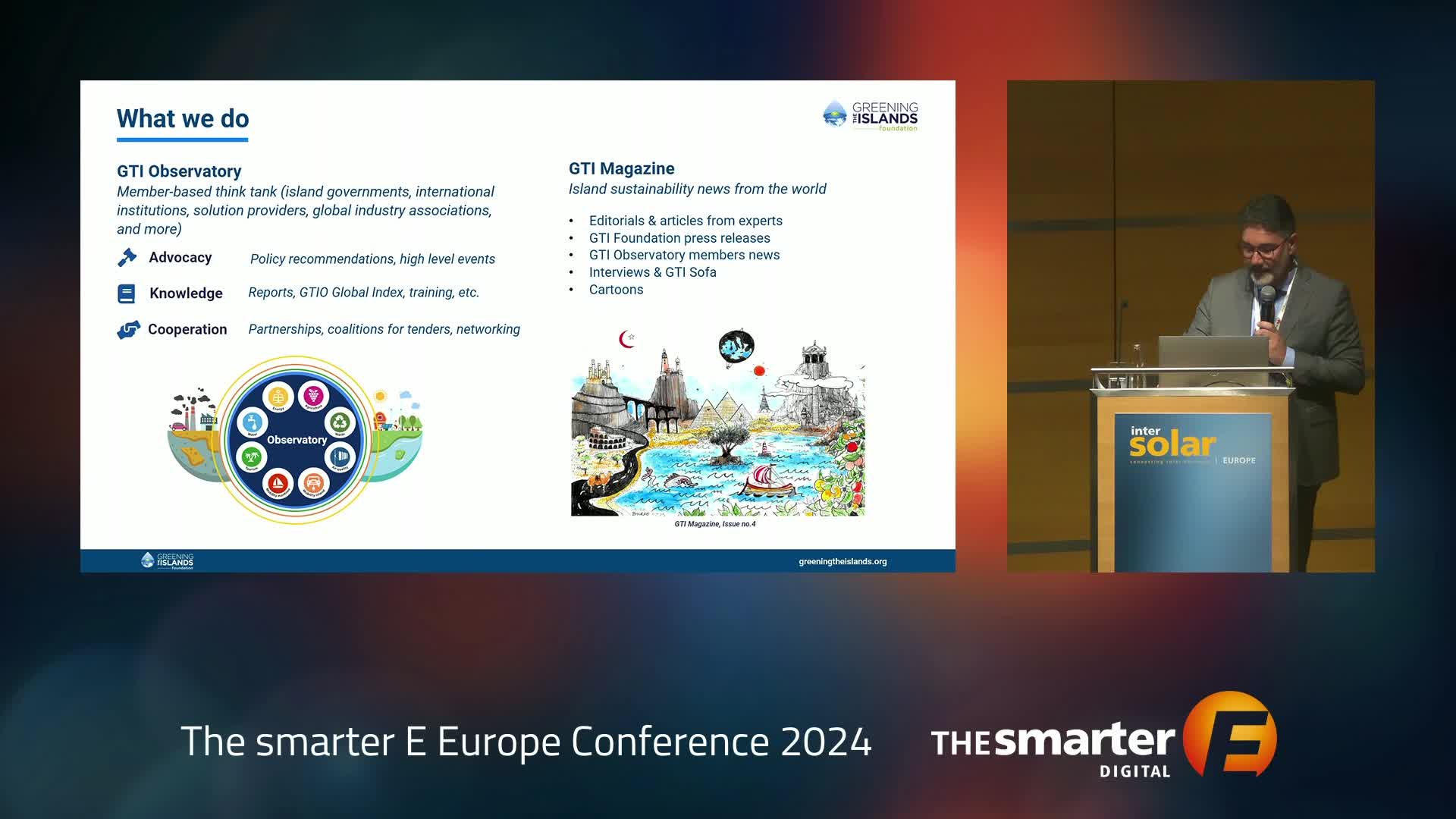
'Setting the Scene' From the Greening the Islands Initiative

premium account

Recording of Wednesday, June 19, 2024 | The smarter E Europe | Conference Program | Language: English | Duration: 18:33 .

Islands as Renewable Energy Leaders: Malta Demonstrates Feasibility and Global Collaboration for 100% Sustainable Communities

The speaker from Malta highlights the potential of islands to lead in sustainable development and renewable energy. Despite challenges like climate change, he sees islands as unique opportunities to model 100% renewable communities on a small scale that can be replicated globally. His foundation focuses on advocacy, knowledge sharing, and cooperation through observatories and publications. They create roadmaps for transitioning island energy systems to 100% renewables by analyzing existing data, demand forecasts, and suitable technologies. Partnerships with institutions like the United Nations Division of Seeds help drive these initiatives forward. Initially studying three islands—Corazão, Rodrigues, and Tonga—they aim to expand involvement worldwide. Their methodology involves forming committees with local stakeholders (governments, utilities) ensuring broad support for chosen scenarios. Identifying feasible projects is key; they provide detailed plans matching projects with funding opportunities through public-private partnerships. Progress includes collaborations announced at Climate Week NYC and COP28 agreements aiming for comprehensive reports by COP29 in Baco.

Automated summarization by AI Conver

Gianni Chianetta
Chair
Greening the Islands Foundation
Italy

Small islands and remote areas contend with heightened costs in energy and its access, water, and waste, exacerbated by climate change. Scaling renewables, creating decentralized smart grids, and integrating storage solutions emerge as pivotal strategies to bolster resilience and spur socio-economic development. Islands and remote areas, serving as testbeds, exemplify the feasibility of decarbonization. This panel discussion provides a platform to delve into these specific insights from islands and remote areas, shedding light on the transformative role of renewables in empowering communities, accelerating transitions, and serving as models for sustainable development.

Further Talks of this session:

Speaker

Lea Dunst
International Project Manager
BSW - German Solar Association
Germany

To Talk

Speaker

David Wedepohl
Managing Director International Affairs
BSW - German Solar Association
Germany

Michael Schmidt
Deputy Head
UNIDO Investment and Technology Promotion Office Germany
Germany

Daniela Krahl
Senior Policy Officer
BMZ - Federal Ministry for Economic Cooperation and Development
Germany

Lisa R. Cummins
Minister of Energy and Business
Government of Barbados
Barbados

Dr. Hamed Beheshti
Co-founder & CEO
Boreal Light GmbH
Germany

To Talk

To Talk

Speaker

Lea Dunst
International Project Manager
BSW - German Solar Association
Germany

To Talk

Further Content
Webinar
Growth of the European Solar Market, Specifically, Romania

February 24, 2026

Webinar: EU Solar Market Overview with Focus on Romania

Webinar Collection
Mixed Investment Solar Projects in Mexico: The 54% Model Explained

January 29, 2026

Mexico has introduced a new mixed investment scheme for renewable power generation, requiring a minimum 54% direct or indirect participation by CFE.

Adriana Fricke, Robin Berg
Has Vehicle-to-Grid Reached the Tipping Point?

The smarter E Podcast Episode 248 | Language: English

February 5, 2026

Why 2026 could be a turning point for bidirectional EV charging – from regulation to large V2G fleets in Europe.

Webinar
Mexico’s commercial and industrial solar thermal: from potential to projects

February 19, 2026

Discover Mexico’s C&I solar thermal market, opportunities, trends and successful projects

The smarter E Europe Conferences 2025
Factors That Influence the Success of a Minigrid Project

Wednesday, May 07, 2025, 11:00 am - 12:30 pm

The smarter E Europe Conferences 2025 | Conference Program

premium account

Off-grid solar systems are often the least expensive option for rural electrification. Solar home systems can power individual households, while mini-grids can supply entire villages. Each comes with its own advantages, disadvantages, and challenges. The aim of this session is to explore challenges as well as success stories. It takes well-functioning components such as battery systems, charge management and inverters to make projects successful. Proper system sizing, maintenance and repair management, as well as a robust financial concept are also necessary. If one of these elements is missing, the electrification will not be sustainable. This session will focus on the aspects mentioned above. The speakers will present successful and unsuccessful approaches and discuss what can be learned from them.

You are using an outdated browser

The website cannot be viewed in this browser. Please open the website in an up-to-date browser such as Edge, Chrome, Firefox, or Safari.