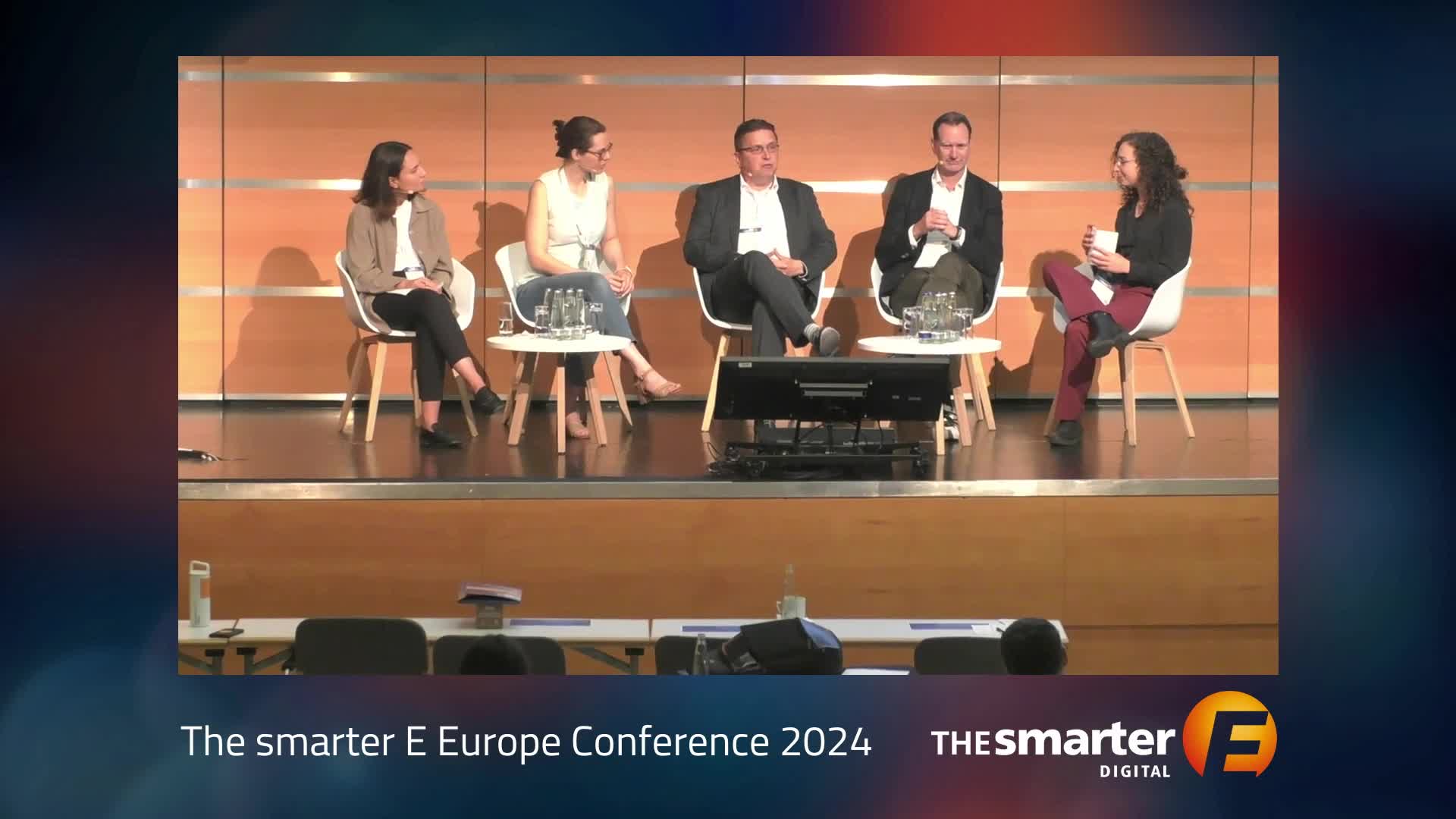
Q&A

Premium Account

Recording of Wednesday, June 19, 2024 | The smarter E Europe | Conference Program | Language: English | Duration: 25:16 .

Panel Discusses Key Policies and Incentives to Promote Smart Charging and EV Adoption Among Truck Fleets

The discussion revolves around policies and strategies to incentivize truck drivers to adopt depot charging, particularly utilizing solar hours. Yulia emphasizes two primary policy ingredients: planning and pricing. The planning involves detailed network projections for charging demand in specific regions, necessitating collaboration between transport and energy stakeholders. In Europe, large grid operators are mandated to update their network investment plans biennially; however, precise data is often lacking. For efficient grid use and smart charging optimization, dynamic time-varying pricing is crucial. Without cost-reflective tariffs that vary with time of day, there’s no incentive for fleet operators to shift their charging schedules. Florence discusses the challenges faced by fleet managers transitioning fleets towards EVs while managing new climate targets. She notes that incentives such as discounted photovoltaic-supported on-site charging can encourage more employees back into offices while facilitating the transition. Both speakers highlight the importance of education and firsthand experience through methods like test drives for increasing EV adoption among users unfamiliar with electric vehicles' benefits.

Automatisierte Zusammenfassung durch AI Conver

Be involved in an exciting session on the future of sustainable e-mobility. We will explore the key role of charging infrastructure and its contribution to a greener future. Learn from research experts and industry leaders how battery size affects power consumption and convenience, and why we need smaller cars and more charging stations. Session topics include smart charging for a greener and cheaper grid, empowering sustainability with battery storage, AI revolutionizing fleet energy usage, and charging event optimization.The aim of this session is to provide an overview of measures to make e-mobility more sustainable when it comes to charging infrastructure and to initiate discussions between participants that will continue throughout the conference. Don't miss your chance to shape the e-mobility charging landscape of tomorrow!

Further Talks of this session:

Speaker

Marie Rajon Bernard
Researcher
ICCT (International Council on Clean Transportation)
Germany

To Talk

Speaker

Carolina Rodrigues Poupinha
Associate Researcher
ICCT (International Council on Clean Transportation)
Germany

To Talk

Speaker

Marie Rajon Bernard
Researcher
ICCT (International Council on Clean Transportation)
Germany

To Talk

Speaker

Dr. Julia Hildermeier
Senior Associate EU
Regulatory Assistance Project (RAP)
Belgium

To Talk

Speaker

Uwe Augustat
Head of Vertical Solutions
Siemens AG
Germany

To Talk

Speaker

Florian Lüft
Head of Business Development
Univers
France

To Talk

Speaker

Conference Partner

Marie Rajon Bernard
Researcher
ICCT (International Council on Clean Transportation)
Germany

To Talk

Weiterführende Inhalte
Thomas Raffeiner and Petrouschka Werther
What EV Acceleration Means for the Grid

The smarter E Podcast Episode 260 | Language: English

July 9, 2026

Cars as batteries on wheels: Thomas Raffeiner and Petrouschka Werther discuss how V2G and smart charging turn EVs into critical grid assets.

The smarter E Europe Conferences 2026
Lessons From a Recycler in a First-Moving Market

Tuesday, June 23, 2026, 02:30 pm

The smarter E Europe Conferences 2026 | Conference Program

Premium Account

For more than two decades, Norway has been steadily building a marketplace for electric transport. Having started out with inexpensive short-range electric cars and household charging sockets, Norway has now moved to mass-market solutions where fast charging (DC) and grid balancing (AC) plays an ever more vital role. With more than 1,000,000 electric cars and over 10,000 fast chargers in a relatively small market, Norway offers a rare early view of large-scale electrification. Over the past decade, electric cars have seen substantial improvements, which is now making it easier for new markets to advance electrification. At the same time, Norway has to deal with challenges years before other markets do. Yet despite different starting points, we can see that most markets are facing the same core challenges. From grid-smart charging strategies to innovative business models, there are excellent examples of best practices emerging elsewhere in Europe. What will the next thing in electrification be, both in mature and in emerging markets? And what will be possible when the right people and companies come together, sharing knowledge, solving common problems and accelerating the shift to cleaner mobility?

The smarter E Europe Conferences 2026
Vehicle to Grid: From Idea to Reality

Tuesday, June 23, 2026, 02:30 pm

The smarter E Europe Conferences 2026 | Conference Program

Premium Account

For more than two decades, Norway has been steadily building a marketplace for electric transport. Having started out with inexpensive short-range electric cars and household charging sockets, Norway has now moved to mass-market solutions where fast charging (DC) and grid balancing (AC) plays an ever more vital role. With more than 1,000,000 electric cars and over 10,000 fast chargers in a relatively small market, Norway offers a rare early view of large-scale electrification. Over the past decade, electric cars have seen substantial improvements, which is now making it easier for new markets to advance electrification. At the same time, Norway has to deal with challenges years before other markets do. Yet despite different starting points, we can see that most markets are facing the same core challenges. From grid-smart charging strategies to innovative business models, there are excellent examples of best practices emerging elsewhere in Europe. What will the next thing in electrification be, both in mature and in emerging markets? And what will be possible when the right people and companies come together, sharing knowledge, solving common problems and accelerating the shift to cleaner mobility?

The smarter E Europe Conferences 2026
How Optimized Lifetime Site Economics and Architecture Guaranteeing Lowest Cost per KW/H and Highest Up-Time and Reliability

Tuesday, June 23, 2026, 02:30 pm

The smarter E Europe Conferences 2026 | Conference Program

Premium Account

For more than two decades, Norway has been steadily building a marketplace for electric transport. Having started out with inexpensive short-range electric cars and household charging sockets, Norway has now moved to mass-market solutions where fast charging (DC) and grid balancing (AC) plays an ever more vital role. With more than 1,000,000 electric cars and over 10,000 fast chargers in a relatively small market, Norway offers a rare early view of large-scale electrification. Over the past decade, electric cars have seen substantial improvements, which is now making it easier for new markets to advance electrification. At the same time, Norway has to deal with challenges years before other markets do. Yet despite different starting points, we can see that most markets are facing the same core challenges. From grid-smart charging strategies to innovative business models, there are excellent examples of best practices emerging elsewhere in Europe. What will the next thing in electrification be, both in mature and in emerging markets? And what will be possible when the right people and companies come together, sharing knowledge, solving common problems and accelerating the shift to cleaner mobility?

The smarter E Europe Conferences 2026
Policy Guidelines and the Experiences of Electric Vehicle Drivers

Tuesday, June 23, 2026, 02:30 pm

The smarter E Europe Conferences 2026 | Conference Program

Premium Account

For more than two decades, Norway has been steadily building a marketplace for electric transport. Having started out with inexpensive short-range electric cars and household charging sockets, Norway has now moved to mass-market solutions where fast charging (DC) and grid balancing (AC) plays an ever more vital role. With more than 1,000,000 electric cars and over 10,000 fast chargers in a relatively small market, Norway offers a rare early view of large-scale electrification. Over the past decade, electric cars have seen substantial improvements, which is now making it easier for new markets to advance electrification. At the same time, Norway has to deal with challenges years before other markets do. Yet despite different starting points, we can see that most markets are facing the same core challenges. From grid-smart charging strategies to innovative business models, there are excellent examples of best practices emerging elsewhere in Europe. What will the next thing in electrification be, both in mature and in emerging markets? And what will be possible when the right people and companies come together, sharing knowledge, solving common problems and accelerating the shift to cleaner mobility?

Sie verwenden einen veralteten Browser

Die Website kann in diesem Browser nicht angezeigt werden. Bitte öffnen Sie die Website in einem aktuellen Browser wie Edge, Chrome, Firefox oder Safari.