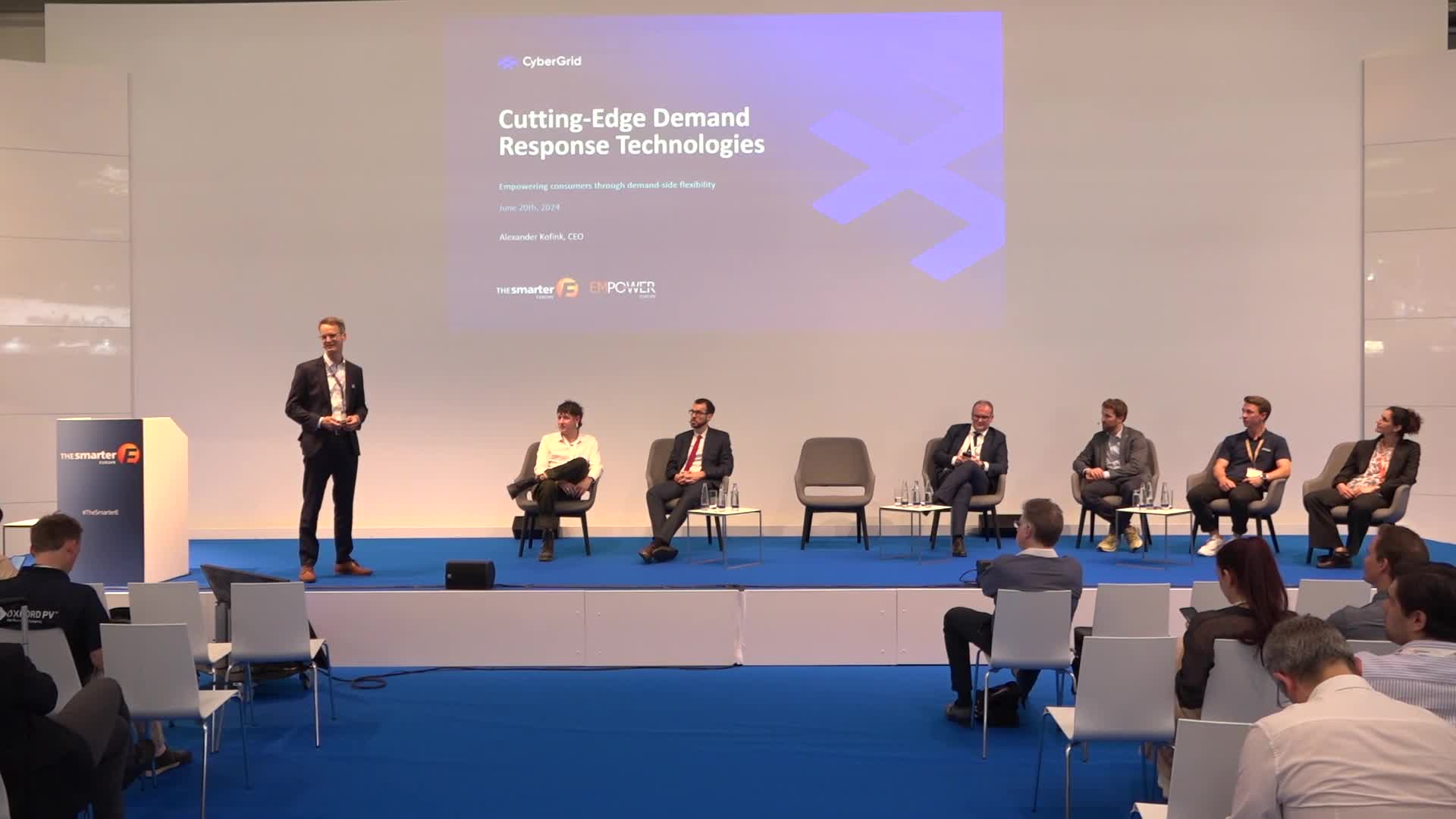
Cutting-Edge Demand Response Technologies

Premium Account

Recording of Thursday, June 20, 2024 | The smarter E Europe 2024 | Exhibition Program | Language: English | Duration: 10:42 .

CyberGrid Advocates for Demand-Response Management to Achieve Net Zero Emissions by 2050, Highlighting the Integration of Renewable Energy and Flexibility in Market Dynamics

Alexander from CyberGrid discussed the significance of demand response management in the energy sector, likening it to "rock and roll" due to its complexity and potential benefits. He emphasized that integrating millions into the energy market is crucial for optimizing existing flexibility and avoiding unnecessary investments. This approach aids in achieving net-zero emissions by 2050 through increased use of renewables and system flexibility. CyberGrid’s vision includes all electricity being renewable and flexible, with batteries playing a pivotal role in this transformation. Alexander highlighted steep growth projections for cumulative energy storage, noting past underestimations by consultancy firms about market speed. Since 2010, CyberGrid has evolved from peak shaving solutions to comprehensive demand response management platforms capable of integrating various asset sizes efficiently via plug-and-play mechanisms. The company developed sound forecasting tools essential for reliable delivery on market promises. Austrian companies CyberGrid and EVN launched Green Deflex, aiming to reduce CO2 emissions significantly by shifting electricity usage among residential customers. The project targets saving 3,500 tons of CO2 annually by engaging around 3,000 households initially. Finally, Alexander outlined three optimization layers: maximizing self-consumption behind-the-meter PV systems; forming renewable energy communities; marketing excess flexibility to create additional value while reducing reliance on traditional power plants or curtailment scenarios.

Automatisierte Zusammenfassung durch AI Conver

A decentralised, flexible energy system puts energy consumers at the fore-front of the clean energy transition. Through demand-side flexibility, consumers are able to adjust their consumption, store energy, and inject energy into the grid during peak moments, contributing to a more efficient and sustainable decarbonisation pathway. smartEn has calculated that, with help from flexible consumers, in 2030 the EU energy system could avoid 15.5 TWh in renewable energy curtailment, a 61% improvement compared to if no action is taken, and avoid investments in 60 GW of peak generation capacity, equivalent to 137 gas peaking plants, resulting in €2.7 billion saved annually. This session aims to deep-dive into how decentralised assets such as PV, Stationary and Mobile storage, amongst others, are key to reducing costs for consumers, increasing the uptake of renewables and solving grid congestion issues.

Further Talks of this session:

To Talk

To Talk

To Talk

To Talk

To Talk

To Talk

To Talk

Weiterführende Inhalte
Webinar
Mixed Investment Solar Projects in Mexico: The 54% Model Explained

January 29, 2026

Mexico has introduced a new mixed investment scheme for renewable power generation, requiring a minimum 54% direct or indirect participation by CFE.

Anna Darmani, Principal Analyst from Wood Mackenzie
Big BESS Is Here to Save the Day

The smarter E Podcast Episode 246 | Language: English

January 8, 2026

Utility-scale batteries are booming in Europe. Discover key BESS trends, market impacts, and what to expect for large-scale storage in 2026.

The smarter E Europe Exhibition Program 2025
DC Microgrids as the Next Frontier in Grid Modernization and DER Integration

Wednesday, May 07, 2025, 11:00 am - 12:25 pm

The smarter E Europe Exhibition Program 2025 | Exhibition Program

Premium Account

Discover how next-gen distribution grid technologies are addressing the challenges of renewable integration and dynamic energy demands. This session offers insights into the latest developments in AI-driven data analytics and the transformative role of IoT in grid management.

Irene Guerra Gil, Mark Bruno
Staying Home, with Smart Energy Management

The smarter E Podcast Episode 245 | Language: English

December 11, 2025

Irene Guerra Gil and Mark Bruno explain how smart home energy systems and building initiatives cut costs and emissions.

The smarter E Europe Conferences 2025
Factors That Influence the Success of a Minigrid Project

Wednesday, May 07, 2025, 11:00 am - 12:30 pm

The smarter E Europe Conferences 2025 | Conference Program

Premium Account

Off-grid solar systems are often the least expensive option for rural electrification. Solar home systems can power individual households, while mini-grids can supply entire villages. Each comes with its own advantages, disadvantages, and challenges. The aim of this session is to explore challenges as well as success stories. It takes well-functioning components such as battery systems, charge management and inverters to make projects successful. Proper system sizing, maintenance and repair management, as well as a robust financial concept are also necessary. If one of these elements is missing, the electrification will not be sustainable. This session will focus on the aspects mentioned above. The speakers will present successful and unsuccessful approaches and discuss what can be learned from them.

Sie verwenden einen veralteten Browser

Die Website kann in diesem Browser nicht angezeigt werden. Bitte öffnen Sie die Website in einem aktuellen Browser wie Edge, Chrome, Firefox oder Safari.