Addressing the Needs of the Residential Market

premium account

Recording of Tuesday, June 18, 2024 | The smarter E Europe 2024 | Conference Program | Language: English | Duration: 10:12 .

Family-Run German Solar Company Highlights Evolution of Residential Market and Future Trends in PV Installation

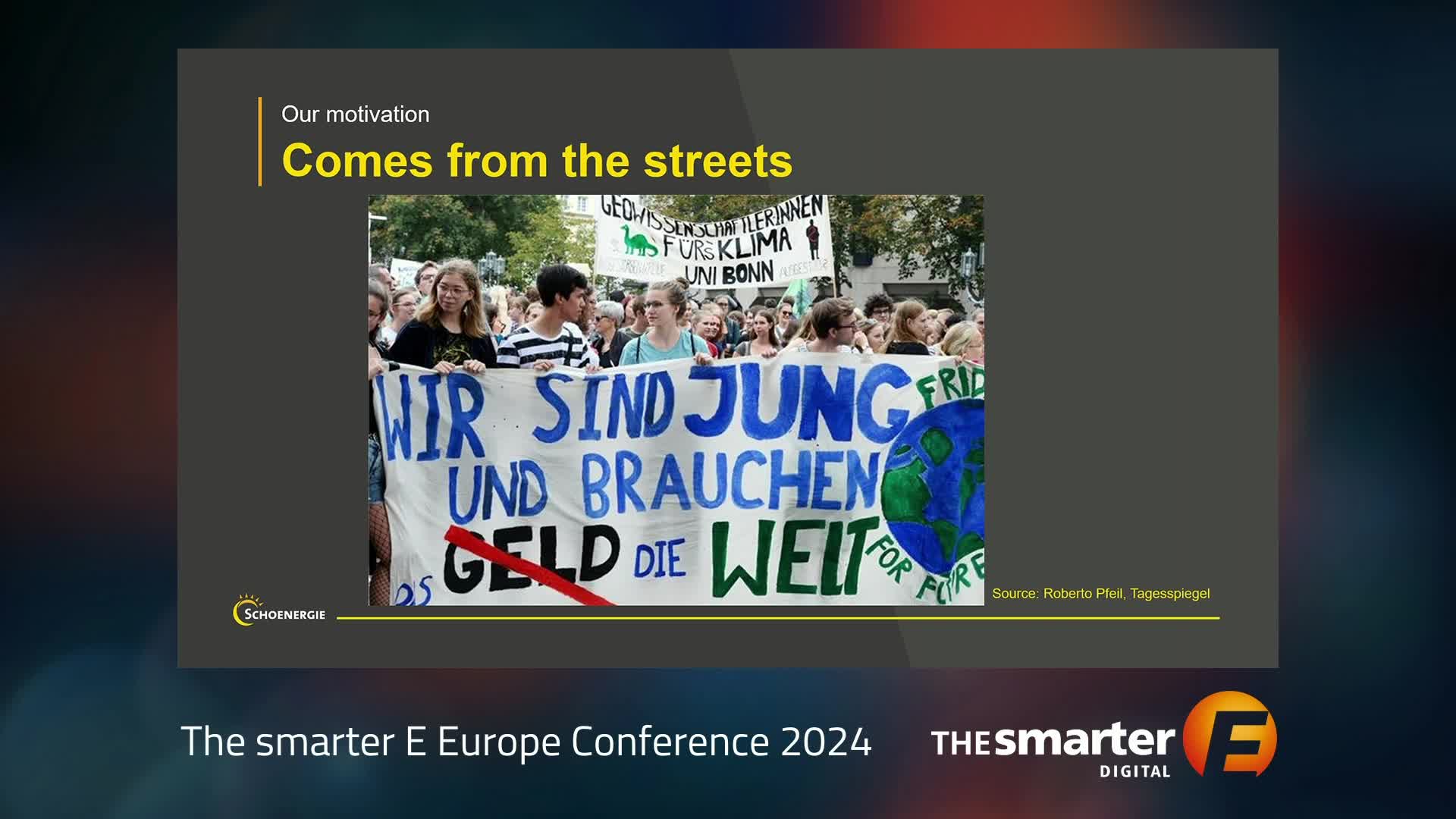
The speaker begins by introducing himself as the youngest of four brothers involved in their family business, which operates in the German residential market. He shares a brief personal background and describes each brother's role within the company, highlighting its origins 15 years ago when they decided to pursue this venture inspired by their idealist father. Their company, Schoenergie, has grown significantly over the years from a small team to over 300 employees with six sites across various suburban areas near cities like Trier and Cologne. They have completed an impressive number of projects—4,000 currently compared to 2,000 just two or three years prior. The presentation reflects on changes in solar energy investment motivations since their first installation in 2008. Initially driven by high feed-in tariffs and low installation costs making it akin to a savings account model for investors; today’s investments are more about security against rising energy prices and fostering independence through Photovoltaic (PV) systems. Future trends discussed include bidirectional charging for electric vehicles, electricity solutions for tenants and apartment buildings, dynamic energy pricing due to market volatility, and most crucially maintaining quality amidst increasing competition. The speaker underscores that quality assurance is essential for sustaining customer trust throughout project lifetimes. They emphasize that as a family-run business focusing on providing consistent support beyond mere installations remains central tenets of their service philosophy.

Automated summarization by AI Conver

Erik Schöller
Chief Operating Officer
Schoenergie
Germany

The German solar market has always played an outstanding role in the development of PV in Europe. The country has almost continually been the EU's largest market and operated nearly one third of the EU's solar power installations. But can the market grow fast enough and install more than 20 GW per year? This will be necessary to meet its ambitious target of 215 GW of solar capacity by 2030. This session will take a close look at:

  • Status of solar power in Germany today
  • Strategy for meeting the country's ambitious installation targets
  • Analysis of different market segments - residential,
  • C&I and utility-scale The German PV and Battery Storage Market

Speaker

David Wedepohl
Managing Director International Affairs
BSW - German Solar Association
Germany

To Talk

Speaker

Dr. Christoph Kost
Head of Department Energy System Analysis
Fraunhofer Institute for Solar Energy Systems ISE
Germany

To Talk

Speaker

Stefan Müller
COO
Enerparc AG
Germany

To Talk

Speaker

Dr. Dirk Haft
CEO
IBC Solar AG
Germany

To Talk

To Talk

Further Content
Webinar
Mixed Investment Solar Projects in Mexico: The 54% Model Explained

January 29, 2026

Mexico has introduced a new mixed investment scheme for renewable power generation, requiring a minimum 54% direct or indirect participation by CFE.

Anna Darmani, Principal Analyst from Wood Mackenzie
Big BESS Is Here to Save the Day

The smarter E Podcast Episode 246 | Language: English

January 8, 2026

Utility-scale batteries are booming in Europe. Discover key BESS trends, market impacts, and what to expect for large-scale storage in 2026.

The smarter E Europe Conferences 2025
Setting the Scene "Affodability"

Wednesday, May 07, 2025, 04:00 pm - 05:30 pm

The smarter E Europe Conferences 2025 | Conference Program

premium account

Photovoltaic prices have fallen continuously in recent years - a trend that should translate into a growing market for off-grid solutions. Declining costs are crucial for rural electrification in particular, making sustainable energy supply economically viable in remote regions. However, so far many of these price advantages have not yet reached the people that need them most. Do existing framework conditions to foster rural electrification still work in this new market reality? Which measures are needed to ensure that cost reductions reach our target group? This session discusses strategies for improving the availability of low-cost off-grid solutions, financing and innovative business models. A look at successful practical examples shows which political, economic and technological levers need to be pulled to make off-grid PV accessible on a large scale.

The smarter E Europe Conferences 2025
Setting the Scene "Off-Grid"

Wednesday, May 07, 2025, 04:00 pm - 05:30 pm

The smarter E Europe Conferences 2025 | Conference Program

premium account

Photovoltaic prices have fallen continuously in recent years - a trend that should translate into a growing market for off-grid solutions. Declining costs are crucial for rural electrification in particular, making sustainable energy supply economically viable in remote regions. However, so far many of these price advantages have not yet reached the people that need them most. Do existing framework conditions to foster rural electrification still work in this new market reality? Which measures are needed to ensure that cost reductions reach our target group? This session discusses strategies for improving the availability of low-cost off-grid solutions, financing and innovative business models. A look at successful practical examples shows which political, economic and technological levers need to be pulled to make off-grid PV accessible on a large scale.

The smarter E Europe Conferences 2025
Factors That Influence the Success of a Minigrid Project

Wednesday, May 07, 2025, 11:00 am - 12:30 pm

The smarter E Europe Conferences 2025 | Conference Program

premium account

Off-grid solar systems are often the least expensive option for rural electrification. Solar home systems can power individual households, while mini-grids can supply entire villages. Each comes with its own advantages, disadvantages, and challenges. The aim of this session is to explore challenges as well as success stories. It takes well-functioning components such as battery systems, charge management and inverters to make projects successful. Proper system sizing, maintenance and repair management, as well as a robust financial concept are also necessary. If one of these elements is missing, the electrification will not be sustainable. This session will focus on the aspects mentioned above. The speakers will present successful and unsuccessful approaches and discuss what can be learned from them.

You are using an outdated browser

The website cannot be viewed in this browser. Please open the website in an up-to-date browser such as Edge, Chrome, Firefox, or Safari.