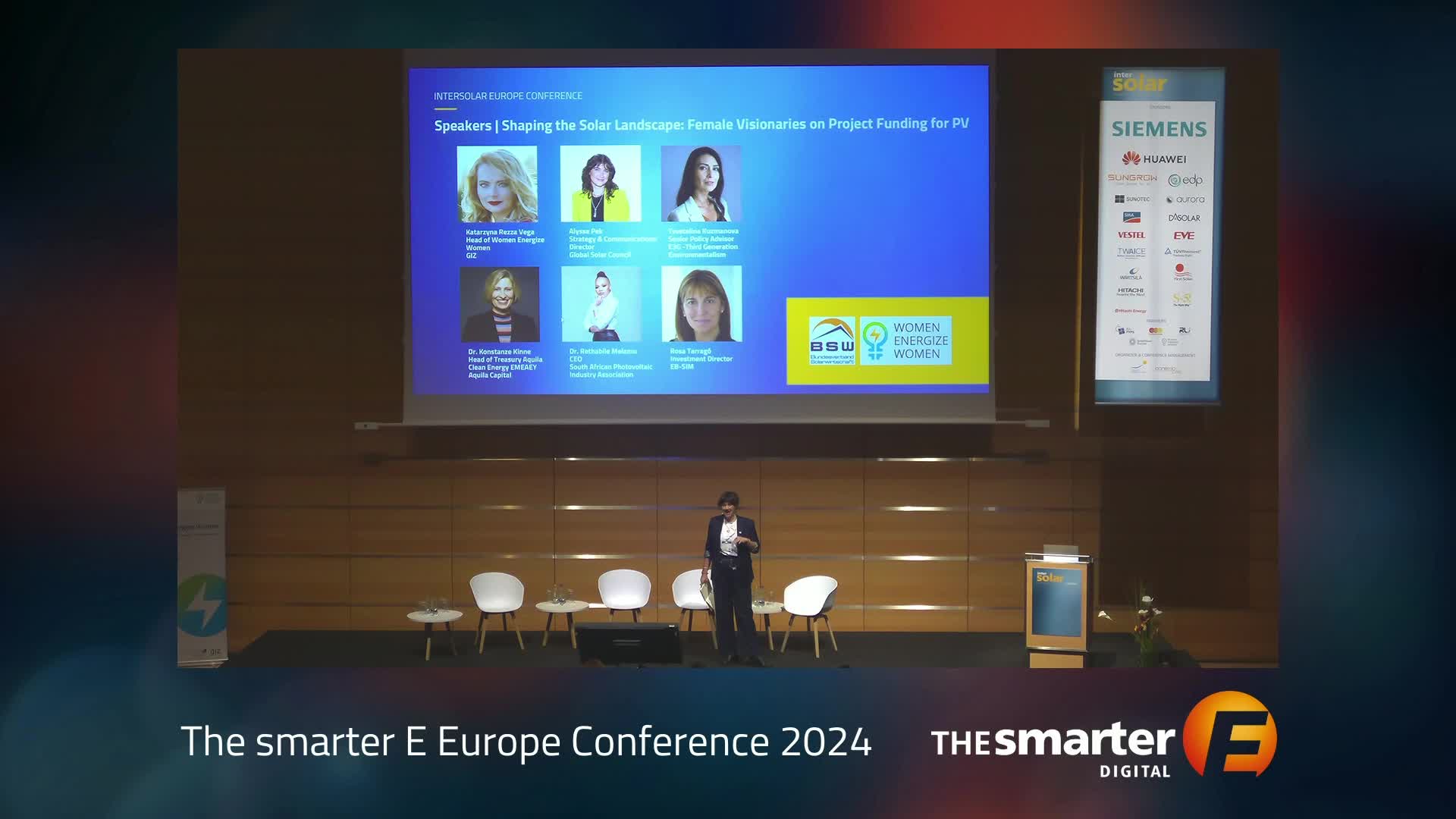
Welcome & Introduction

Premium Account

Recording of Wednesday, June 19, 2024 | The smarter E Europe | Conference Program | Language: English | Duration: 4:13 .

Global Solar Council Calls for Major Financial Shift to Achieve Tripling of Renewable Energy by 2030, Highlighting Need for $10-12 Trillion Investment and Equitable Distribution Across Emerging Markets

The session aims to address the need for innovative finance solutions to meet a significant renewable energy goal set by global stakeholders, including the Global Solar Council. The objective is to triple renewable energy capacity by 2030, with solar contributing at least half of this growth, translating into 11 terawatts of renewable energy and requiring $10-12 trillion in investment. While substantial funds are available globally—evident from the $1.4 trillion annually invested in fossil fuels by G20 countries—the challenge lies in redirecting these funds towards clean energy. In 2022, around $1.3 trillion was invested annually in the clean energy transition; however, only about $0.5 trillion went specifically to renewables. Achieving the tripling target necessitates increasing annual investments in renewables alone to at least $1.3 trillion by 2030. Furthermore, equitable distribution of financial resources remains a critical issue as most current investments favor China, Europe, and the US while regions like Sub-Saharan Africa receive minimal funding (only 1% of global investment). The session will explore ways to scale up financing more equitably across emerging markets and mature ones alike through expert insights such as those provided by Tsvetelina Kuzmanova from E3G on sustainable finance regulations in Europe.

Automatisierte Zusammenfassung durch AI Conver

Katarzyna Rezza Vega
Head of Women Energize Women
German Corporation for International Cooperation (GIZ) GmbH
Madagascar

Despite the global exponential growth of solar power, challenges currently loom large — from soaring debt costs to dwindling capture prices and escalating curtailment rates. These hurdles threaten to impede deployment growth in the urgent race to triple renewables installation by 2030. The pressure for innovative solutions and rapid action is high, and financing is key. Our session will therefore convene investors, developers and financing institutions to analyze key issues and explore new perspectives on solar finance, with the aim of driving the realization of a sustainable and prosperous future through advanced solar initiatives.

Topics will include:
1. Assessing financing conditions for solar power plants
2. Analyzing the impact of policy shifts on PV project financing
3. Strategizing to enhance solar project financing

This panel discussion is organized by the Bundesverband Solarwirtschaft (BSW-Solar) in cooperation with the Women Energize Women (WEW) initiative. Women Energize Women (#womenenergize) is a campaign for the global empowerment of women in the energy sector by the Federal Ministry for Economic Affairs and Climate Action (BMWK). It is implemented by the Deutsche Gesellschaft für Internationale Zusammenarbeit (GIZ) within the scope of BMWK's global project Bilateral Climate and Energy Partnerships and Dialogues. (https://www.womenenergize.org/)

Further Talks of this session:

Speaker

Tsvetelina Kuzmanova
Senior Policy Advisor
E3G -Third Generation Environmentalism
Belgium

To Talk

Speaker

Dr. Konstanze Kinne
Head of Treasury Aquila Clean Energy EMEA
Aquila Capital
The Netherlands

To Talk

Speaker

Rosa Tarragó
Investment Director
EBG compleo GmbH
Germany

Rethabile Melamu
CEO
South African Photovoltaic Industry Association
South Africa

Tsvetelina Kuzmanova
Senior Policy Advisor
E3G -Third Generation Environmentalism
Belgium

Dr. Konstanze Kinne
Head of Treasury Aquila Clean Energy EMEA
Aquila Capital
The Netherlands

To Talk

Weiterführende Inhalte
The smarter E Europe Conferences 2026
Is Solar Cooling a Viable Solution for Agricultural Value Chains? - Challenges and Findings From a Field Study in Kenya

Tuesday, June 23, 2026, 11:30 am

The smarter E Europe Conferences 2026 | Conference Program

Premium Account

For many years, the photovoltaic (PV) market was dominated by grid feed-in systems. Increasingly affordable solar modules and storage systems have been changing this picture. The resulting competitive situation is leading to new results when evaluating whether a grid connection makes sense for a particular use or not. However, off-grid applications for thermal energy are also gaining importance, such as solar-electric heating and cooking. Innovative system design as well as innovative storage and applications are shifting into focus.

The smarter E Europe Conferences 2026
Panel Discussion of the Session: Off-Grid: PV-Based Hydrogen Microgrid Projects Around the World

Tuesday, June 23, 2026, 02:30 pm

The smarter E Europe Conferences 2026 | Conference Program

Premium Account

Discover how green hydrogen and fuel cell technologies are transforming decentralized energy systems worldwide. This session will be presenting hands-on experience from pioneering projects in Thailand, Ghana, Namibia and South Africa. Find out how solar-powered hydrogen microgrids can replace diesel generators, strengthen energy resilience and enable short- to long-term storage, while supporting environmental and climate goals. Project partners including German SMEs and research institutes, share insights on lessons learned, local benefits and the replication potential of these systems. Selected projects were implemented with the support from the Export Initiative Environmental Protection, a funding programme of the German Federal Ministry for the Environment, Climate Action, Nature Conservation and Nuclear Safety. 

The smarter E Europe Conferences 2026
Panel Discussion of the Session: Solar Made in the EU

Tuesday, June 23, 2026, 02:30 pm

The smarter E Europe Conferences 2026 | Conference Program

Premium Account

Despite strong research capabilities and the presence of leading production equipment suppliers, Europe has been struggling to rebuild competitive wafer-to-module manufacturing, while the USA and India have enabled a local renaissance in solar manufacturing. In Europe, even long-established inverter manufacturers have been losing considerable ground. With the EU's Net Zero Industry Act yet to deliver momentum, attention is turning to the upcoming Industry Accelerator Act. This session examines how policy, investment and value-chain strategies can strengthen domestic manufacturing and increase internal value creation.Key topics:Overview of EU and national policy frameworks to support local manufacturingStatus of Europe's solar manufacturing value chainInvestment gaps and competitiveness challenges Strategies for triggering a sustainable solar manufacturing revival 

The smarter E Europe Conferences 2026
From Sheep to Cows: Experience From a Cow-Pv Project in Germany and Its Potential in Europe

Tuesday, June 23, 2026, 02:30 pm

The smarter E Europe Conferences 2026 | Conference Program

Premium Account

Agricultural PV has been moving from pilot to scale, combining food and power production while addressing land scarcity and climate pressure. Yet large-scale deployment is still constrained as it depends on clear policy frameworks, viable business cases, and proven system concepts. Taking inspiration from global developments, this session explores Europe's market potential, diverse applications from livestock to greenhouses, and the economic drivers shaping profitable agriculturalPV projects.This session will address:  Agricultural PV outlook and key business enablers for scale-upReal-world case studiesProgressive policy frameworks in major agricultural PV markets System design options and corresponding business model approachesEconomic, technical and agricultural requirements for utility-scale projects 

The smarter E Europe Conferences 2026
Hybrid Horizons: Co-Location in Europe - Trends, Policy, and Business Models

Tuesday, June 23, 2026, 11:30 am

The smarter E Europe Conferences 2026 | Conference Program

Premium Account

Hybrid PV projects are transforming Europe's utility-scale solar sector. As battery sizes grow and grid constraints intensify, co-location and hybrid operation are becoming the key to accessing the grid and unlocking new value streams - from merchant optimization to industrial energy supply. This session examines real-world revenue models, policy trends and grid-forming requirements,providing background on how hybrid projects truly pay off.This session will address:Business cases for co-location, overplanting and shared grid connections of hybrid solar plantsGrid-forming and related services with regulatory drivers shaping hybrid economics Revenue-stacking strategies in merchant and contracted marketsIndustrial optimization and storage-led value creation in practice 

Sie verwenden einen veralteten Browser

Die Website kann in diesem Browser nicht angezeigt werden. Bitte öffnen Sie die Website in einem aktuellen Browser wie Edge, Chrome, Firefox oder Safari.