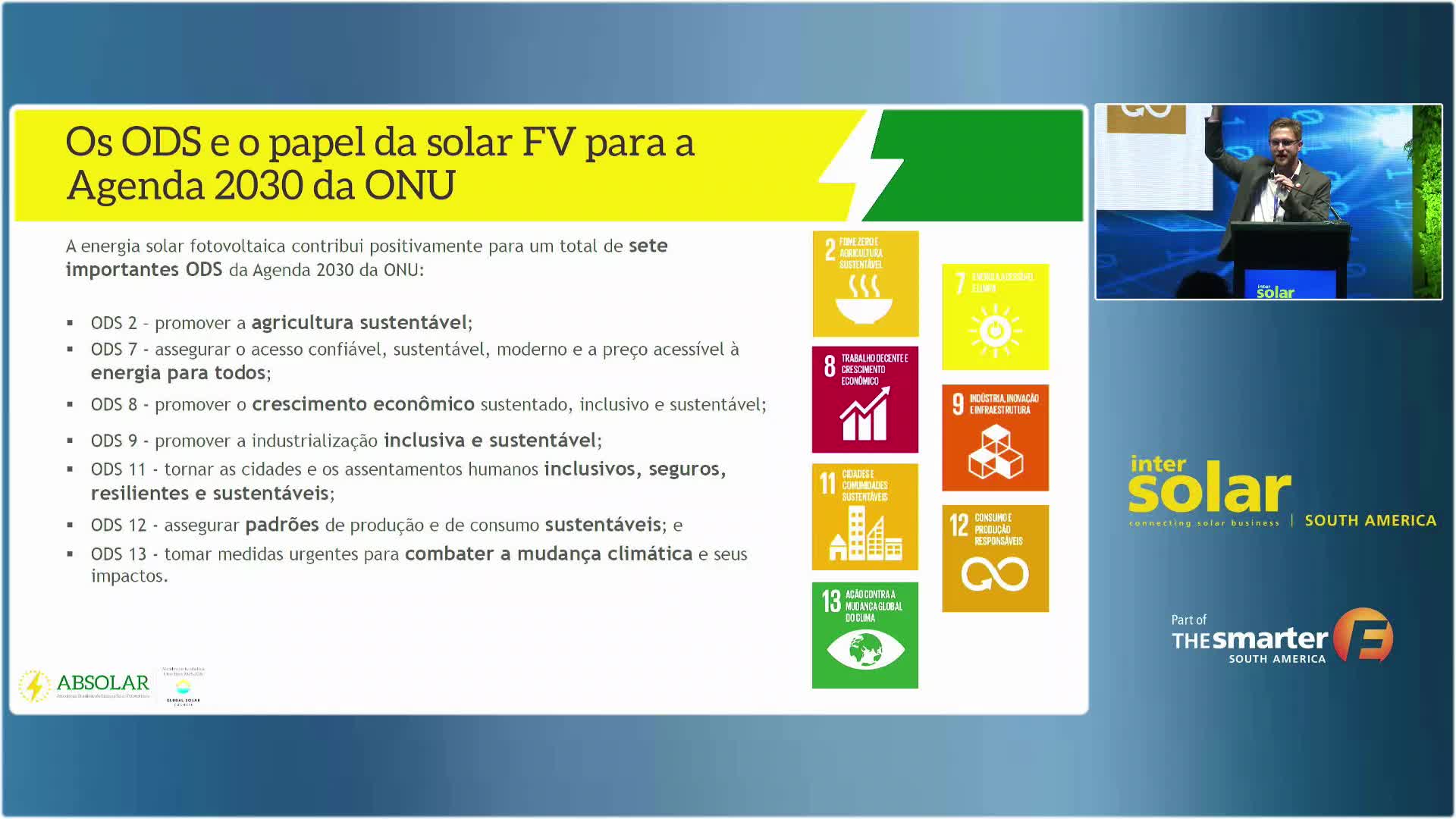
How Solar Can Help Achieve ESG Goals & 2030 Sustainable Development Goals

premium account

Recording of Tuesday, August 27, 2024 | Intersolar South America 2024 | Conference Program | Language: English | Duration: 82:19 .

Brazil's Solar Energy Initiatives Tackle Social Impact, Gender Equality, and Economic Sovereignty Amidst Climate Crisis Challenges

The session on solar energy's role in achieving ESG goals for sustainable development by 2030, coordinated by Eduardo Avila, highlighted the multifaceted impact of solar projects beyond environmental benefits. Discussions emphasized empowering low-income communities through job creation and reduced emissions while promoting gender equality within the sector. Renata Consuelo stressed women's participation via initiatives like the Brazilian Women's Network of Solar Energy to promote inclusivity with a certification methodology assessing companies' efforts. Camila Ham from Litro de Luz shared examples aligning solar illumination with sustainable objectives, underscoring integrating social dimensions into renewable policies as crucial for an equitable transition towards sustainability per global frameworks like SDGs. Liter of Light operates across Brazil using simple techniques involving PET bottles to provide lighting solutions independently maintained by communities since 2014—impacting over 30,000 people including urban areas without public lighting and isolated tribes reliant on generators. Wellington Souza from Alimento Solar discussed generating impacts within socially challenged groups through resources like food production capabilities alongside educational opportunities fostering societal inclusion amidst cleaner energy transitions globally today! Efforts focus on enhancing efficiency and fostering development in Brazil’s favelas; training locals establishes cooperatives creating financial loops supporting livelihoods while partnerships introduce innovative durable tiles contributing back into community funds ensuring long-term success post-project completion stages achieved sustainably throughout territories involved therein ultimately consolidating socio-economic resilience benefiting stakeholders equitably alike!

Automated summarization by AI Conver

A central theme in the contemporary world is the energy transition, which is paving the way for a future where consumers begin to see ESG (Environmental, Social and Governance) practices as a distinguishing factor. However, how is this process developing in Brazil?

Speaker

Eduardo Avila
Executive Director Revolusolar & Coordinator FT ABSOLAR
ABSOLAR
Brazil

Speaker

Graziella Albuquerque
Coordinator of Institutional and Government Relations
Revolusolar
Brazil

Speaker

Michel Sednaoui
CEO
Plexo Solar
Brazil

Speaker

Hamilton Mendes Rocha
Executive Coordinator
Associação Rede Paulista de Bancos Comunitários
Brazil

Speaker

Camila Hammes
Project Manager
Associação Um Litro de Luz Brasil
Brazil

Wellington Tadeu Souza Rodrigues
Presidente/ CEO
ONG Alimento Solar

Speaker

Renata Mansuelo
Core Coordinator Promote
Rede MESol
Brazil

Further Content
Webinar
Mixed Investment Solar Projects in Mexico: The 54% Model Explained

January 29, 2026

Mexico has introduced a new mixed investment scheme for renewable power generation, requiring a minimum 54% direct or indirect participation by CFE.

Anna Darmani, Principal Analyst from Wood Mackenzie
Big BESS Is Here to Save the Day

The smarter E Podcast Episode 246 | Language: English

January 8, 2026

Utility-scale batteries are booming in Europe. Discover key BESS trends, market impacts, and what to expect for large-scale storage in 2026.

The smarter E Europe Conferences 2025
Setting the Scene "Off-Grid"

Wednesday, May 07, 2025, 04:00 pm - 05:30 pm

The smarter E Europe Conferences 2025 | Conference Program

premium account

Photovoltaic prices have fallen continuously in recent years - a trend that should translate into a growing market for off-grid solutions. Declining costs are crucial for rural electrification in particular, making sustainable energy supply economically viable in remote regions. However, so far many of these price advantages have not yet reached the people that need them most. Do existing framework conditions to foster rural electrification still work in this new market reality? Which measures are needed to ensure that cost reductions reach our target group? This session discusses strategies for improving the availability of low-cost off-grid solutions, financing and innovative business models. A look at successful practical examples shows which political, economic and technological levers need to be pulled to make off-grid PV accessible on a large scale.

The smarter E Europe Conferences 2025
Factors That Influence the Success of a Minigrid Project

Wednesday, May 07, 2025, 11:00 am - 12:30 pm

The smarter E Europe Conferences 2025 | Conference Program

premium account

Off-grid solar systems are often the least expensive option for rural electrification. Solar home systems can power individual households, while mini-grids can supply entire villages. Each comes with its own advantages, disadvantages, and challenges. The aim of this session is to explore challenges as well as success stories. It takes well-functioning components such as battery systems, charge management and inverters to make projects successful. Proper system sizing, maintenance and repair management, as well as a robust financial concept are also necessary. If one of these elements is missing, the electrification will not be sustainable. This session will focus on the aspects mentioned above. The speakers will present successful and unsuccessful approaches and discuss what can be learned from them.

The smarter E Europe Conferences 2025
Q&A Session of of the Session Off-Grid: Rural Electrification Based on Solar Systems - Lessons Learned

Wednesday, May 07, 2025, 11:00 am - 12:30 pm

The smarter E Europe Conferences 2025 | Conference Program

premium account

Off-grid solar systems are often the least expensive option for rural electrification. Solar home systems can power individual households, while mini-grids can supply entire villages. Each comes with its own advantages, disadvantages, and challenges. The aim of this session is to explore challenges as well as success stories. It takes well-functioning components such as battery systems, charge management and inverters to make projects successful. Proper system sizing, maintenance and repair management, as well as a robust financial concept are also necessary. If one of these elements is missing, the electrification will not be sustainable. This session will focus on the aspects mentioned above. The speakers will present successful and unsuccessful approaches and discuss what can be learned from them.

You are using an outdated browser

The website cannot be viewed in this browser. Please open the website in an up-to-date browser such as Edge, Chrome, Firefox, or Safari.