The Importance of Asset Management From Development Through Life Cycle of the Project

premium account

Recording of Tuesday, June 18, 2024 | The smarter E Europe 2024 | Conference Program | Language: English | Duration: 11:39 .

Elgin Energy, under CIP ownership, advances integrated IPV project with innovative grid exploration and 3D modeling for enhanced lifecycle management

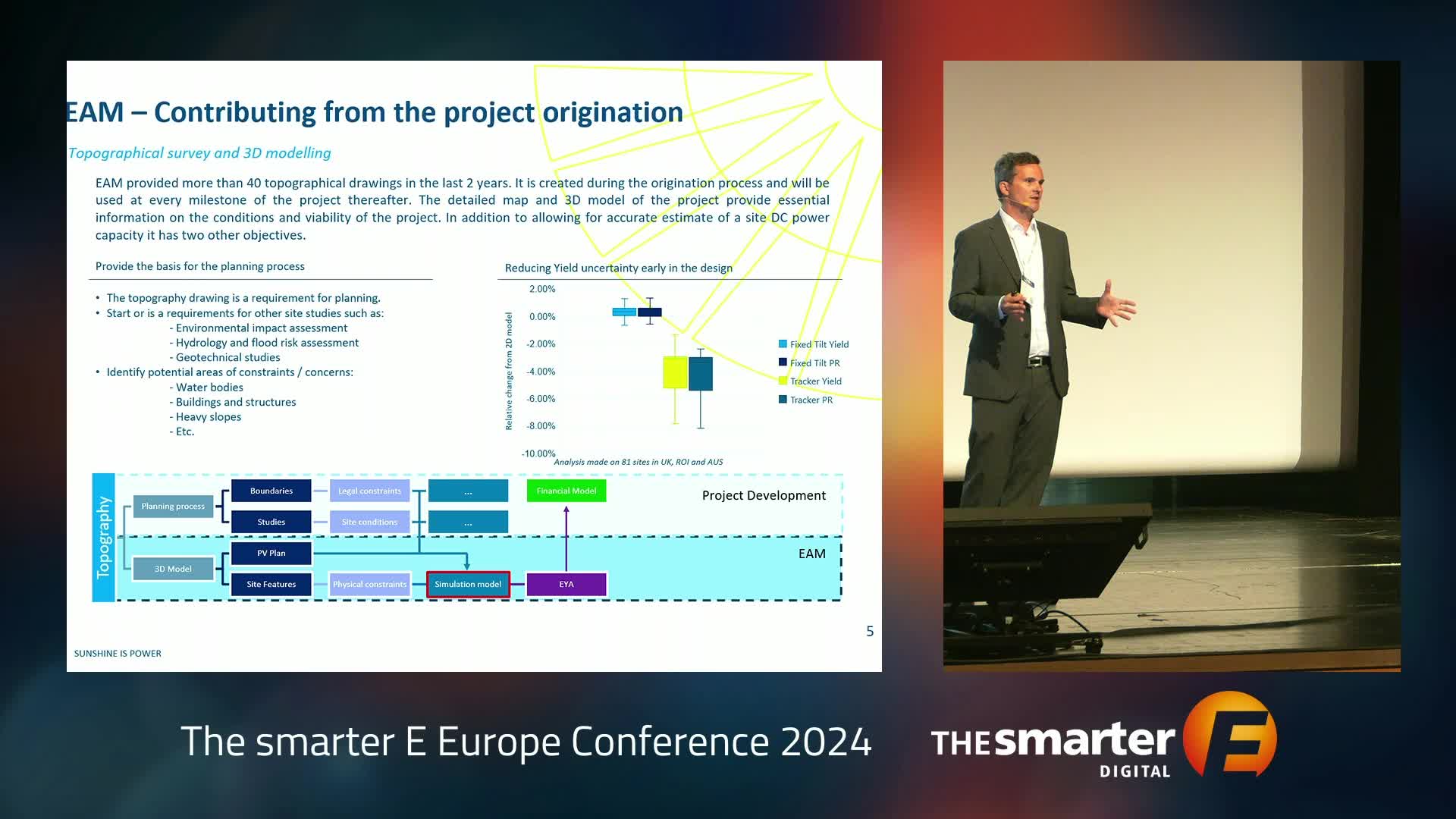
Dr. Carlos Javier Sarasa, Managing Director of ELGIN ENERGY—a company owned by Copenhagen Infrastructure Partners (CIP)—discusses the transition from development to a fully integrated Independent Power Producer (IPV). The presentation covers grid opportunities identification, sensitivity analysis, 3D modeling, topography, site layouts, project lifecycle management, and an overview of ASEM Management within IPV. ELGIN ENERGY has established various business lines but excludes operational maintenance due to potential conflicts with ASEM Management. The initial focus is on Grid Explore—an in-house tool aimed at identifying electricity market opportunities through data programming and network operator collaboration. Moving forward quickly into digitalization strategies for early-stage topographical surveys utilizing photogrammetry reduces uncertainties and integrates hydrological drainage considerations. Lifecycle engineering involves annual project revisions incorporating new technologies. Centralized asset management ensures smooth information flow across construction, trading, and development stages. Furthermore are system loss analyses followed by creating digital twins—detailed replicas of real sites—to facilitate activities such as merchant acquisition simulations and troubleshooting underperforming solar farms without specific performance data.

Automated summarization by AI Conver

Dr. Carlos Javier Sarasa
Managing Director
ELGIN ENERGY
United Kingdom

As regulatory requirements and margin pressure make project development increasingly challenging, EPCs are confronted with new system designs and high volatility in product supply and cost. Once a PV power plant has been built, the O&M needs to ensure a high output. This requires more and more digital analytics, while asset managers must deal with increasing reporting services. The session will cover:

  • Status of utility-scale solar power project development needs
  • How EPCs deal with rising costs and supply volatility pressure
  • Advanced analytics for effective O&M
  • Asset management throughout the entire project lifecycle
  • Q&A

Speaker

Dr. Benedikt Ortmann
Global Director Origination & Business Development Projects
BayWa r.e. AG
Germany

To Talk

Speaker

Martin Dennenmoser
Head of R&D
BayWa r.e. Solar Projects GmbH
Germany

To Talk

Speaker

Aquin Magnus
Project Engineer
ENGIE Laborelec
France

To Talk

Speaker

Dan Garlin
COO Renewables
Uniper
Germany

To Talk

To Talk

Further Content
Webinar
Mixed Investment Solar Projects in Mexico: The 54% Model Explained

January 29, 2026

Mexico has introduced a new mixed investment scheme for renewable power generation, requiring a minimum 54% direct or indirect participation by CFE.

Anna Darmani, Principal Analyst from Wood Mackenzie
Big BESS Is Here to Save the Day

The smarter E Podcast Episode 246 | Language: English

January 8, 2026

Utility-scale batteries are booming in Europe. Discover key BESS trends, market impacts, and what to expect for large-scale storage in 2026.

The smarter E Europe Conferences 2025
Setting the Scene "Off-Grid"

Wednesday, May 07, 2025, 04:00 pm - 05:30 pm

The smarter E Europe Conferences 2025 | Conference Program

premium account

Photovoltaic prices have fallen continuously in recent years - a trend that should translate into a growing market for off-grid solutions. Declining costs are crucial for rural electrification in particular, making sustainable energy supply economically viable in remote regions. However, so far many of these price advantages have not yet reached the people that need them most. Do existing framework conditions to foster rural electrification still work in this new market reality? Which measures are needed to ensure that cost reductions reach our target group? This session discusses strategies for improving the availability of low-cost off-grid solutions, financing and innovative business models. A look at successful practical examples shows which political, economic and technological levers need to be pulled to make off-grid PV accessible on a large scale.

The smarter E Europe Conferences 2025
Factors That Influence the Success of a Minigrid Project

Wednesday, May 07, 2025, 11:00 am - 12:30 pm

The smarter E Europe Conferences 2025 | Conference Program

premium account

Off-grid solar systems are often the least expensive option for rural electrification. Solar home systems can power individual households, while mini-grids can supply entire villages. Each comes with its own advantages, disadvantages, and challenges. The aim of this session is to explore challenges as well as success stories. It takes well-functioning components such as battery systems, charge management and inverters to make projects successful. Proper system sizing, maintenance and repair management, as well as a robust financial concept are also necessary. If one of these elements is missing, the electrification will not be sustainable. This session will focus on the aspects mentioned above. The speakers will present successful and unsuccessful approaches and discuss what can be learned from them.

The smarter E Europe Conferences 2025
Q&A Session of of the Session Off-Grid: Rural Electrification Based on Solar Systems - Lessons Learned

Wednesday, May 07, 2025, 11:00 am - 12:30 pm

The smarter E Europe Conferences 2025 | Conference Program

premium account

Off-grid solar systems are often the least expensive option for rural electrification. Solar home systems can power individual households, while mini-grids can supply entire villages. Each comes with its own advantages, disadvantages, and challenges. The aim of this session is to explore challenges as well as success stories. It takes well-functioning components such as battery systems, charge management and inverters to make projects successful. Proper system sizing, maintenance and repair management, as well as a robust financial concept are also necessary. If one of these elements is missing, the electrification will not be sustainable. This session will focus on the aspects mentioned above. The speakers will present successful and unsuccessful approaches and discuss what can be learned from them.

You are using an outdated browser

The website cannot be viewed in this browser. Please open the website in an up-to-date browser such as Edge, Chrome, Firefox, or Safari.