The Future of PV Systems in a World Increasingly Defined by Extreme Weather

Premium Account

Recording of Wednesday, June 19, 2024 | The smarter E Europe | Conference Program | Language: English | Duration: 17:27 .

International Energy Agency Outlines Strategies to Enhance Resilience of PV Power Plants Amid Escalating Extreme Weather Events

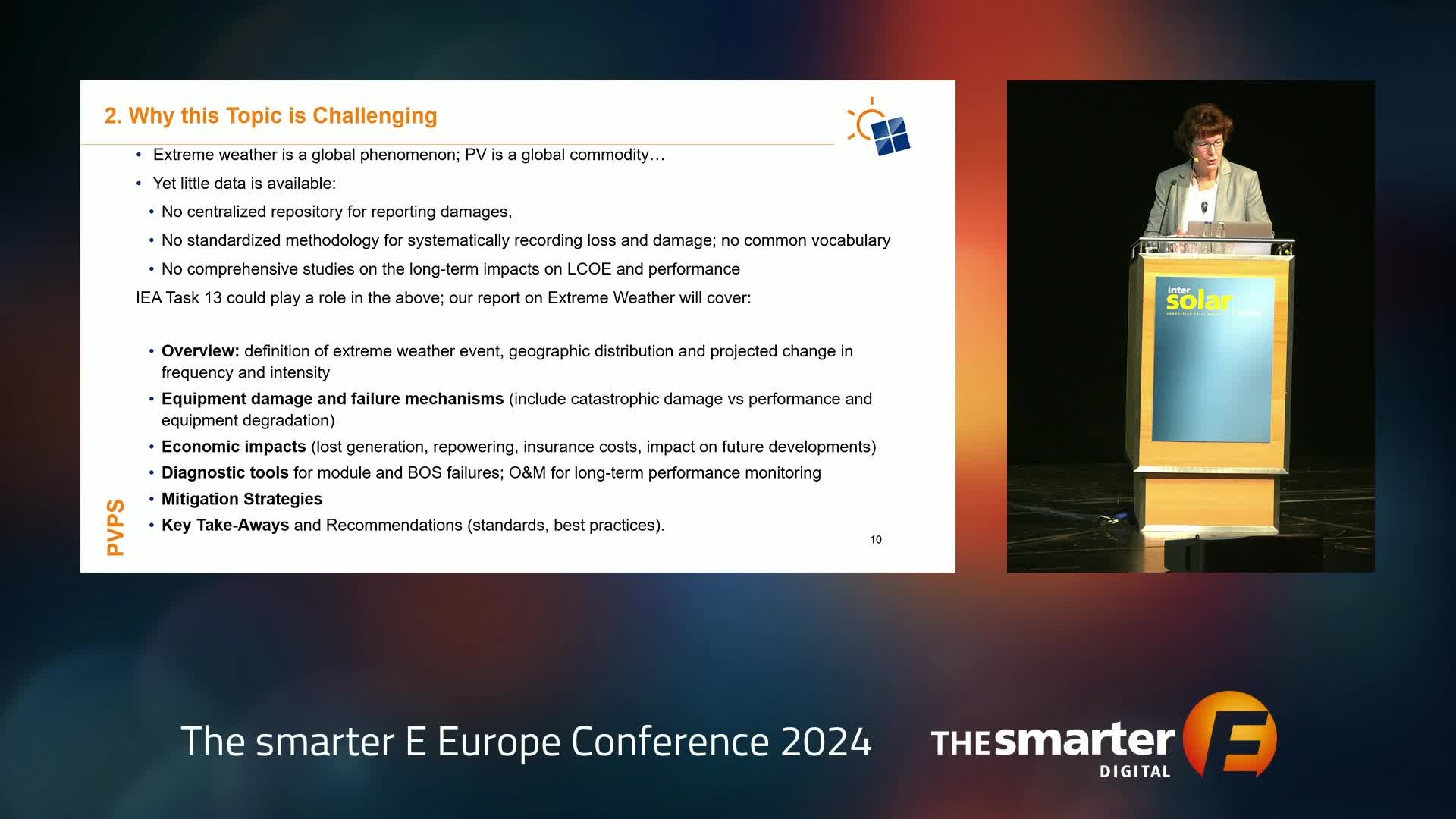
In this talk, the speaker from the International Energy Agency (IEA) discusses their work on ensuring photovoltaic (PV) power plants are resilient against climate change. The presentation is divided into four segments: the necessity of IEA's work for global energy transition, resilience needs of PV plants amidst climate change, types and mitigation of extreme weather events threatening PV systems, and recommendations. The IEA was founded in 1993 to reduce global energy production impacts and collaborates internationally across over 25 countries. Their initiatives focus on applying photovoltaic technology to electricity generation through nine operational research tasks involving more than 340 experts. Extreme weather events such as hurricanes, wildfires, heat waves, hailstorms, snow blizzards, dust storms, and floods pose significant threats to PV systems by reducing yield or causing complete destruction. Mitigation strategies discussed include improved design features like robust fasteners for wind resistance; smaller modules with thicker glass for hail protection; high tilt angles and frameless designs for snow management; regular cleaning regimes for dust control; strategic site selection; elevated system installations; among others. These considerations aim at long-term data analysis to develop best practices that ensure robustness and resiliency of power plants against severe weather phenomena globally.

Automatisierte Zusammenfassung durch AI Conver

Ulrike Jahn
Senior Scientist
Fraunhofer Center for Silicon-Photovoltaics CSP
Germany

If designed and maintained well, solar systems can function for several decades. However, every PV power plant's life ends at some point - even if high-quality components have been used, whether because of age, financial feasibility or extreme weather events. The resulting waste streams need to be managed, but also generate a huge potential for repowering solar installations.

This session will provide:

  • Overview of end-of-life management best practices
  • Product quality control from fab to field
  • Module reliability & performance
  • Repowering solar power plants
  • The impact of extreme weather on climate

Further Talks of this session:

Speaker

Adele Ara
Chief Technology Officer
Lightsource bp
UK

To Talk

Speaker

Magnus Herz
Project Manager
TÜV Rheinland Energy GmbH
Germany

To Talk

Speaker

Sishir Garemella
Head of Interational Business Development
Kiwa PVEL
USA

To Talk

Speaker

Tomaso Charlemont
Head of PV Revamping / Repowering EMEA
BayWa r.e. AG
Germany

To Talk

Weiterführende Inhalte
Publication
The German PV and Battery Storage Market

The first of its kind, this study offers an overview of the photovoltaics and battery storage market in Germany.

Rutger Schlatmann and Angelika Harter
Perovskites: The Race for the Future of PV?

The smarter E Podcast Episode 258 | Language: English

June 25, 2026

HZB researchers explore perovskite tandem solar cells, efficiency gains, and the challenges of bringing the technology to market.

Publications
Global Market Outlook for Solar Power 2025–2029

SolarPower Europe’s annual Global Market Outlook for Solar Power is the most authoritative market analysis for the solar sector.

The smarter E Europe Conferences 2026
Panel Discussion of the Session: Solar Made in the EU

Tuesday, June 23, 2026, 02:30 pm

The smarter E Europe Conferences 2026 | Conference Program

Premium Account

Despite strong research capabilities and the presence of leading production equipment suppliers, Europe has been struggling to rebuild competitive wafer-to-module manufacturing, while the USA and India have enabled a local renaissance in solar manufacturing. In Europe, even long-established inverter manufacturers have been losing considerable ground. With the EU's Net Zero Industry Act yet to deliver momentum, attention is turning to the upcoming Industry Accelerator Act. This session examines how policy, investment and value-chain strategies can strengthen domestic manufacturing and increase internal value creation.Key topics:Overview of EU and national policy frameworks to support local manufacturingStatus of Europe's solar manufacturing value chainInvestment gaps and competitiveness challenges Strategies for triggering a sustainable solar manufacturing revival 

The smarter E Europe Conferences 2026
Panel Discussion of the Session: Off-Grid: PV-Based Hydrogen Microgrid Projects Around the World

Tuesday, June 23, 2026, 02:30 pm

The smarter E Europe Conferences 2026 | Conference Program

Premium Account

Discover how green hydrogen and fuel cell technologies are transforming decentralized energy systems worldwide. This session will be presenting hands-on experience from pioneering projects in Thailand, Ghana, Namibia and South Africa. Find out how solar-powered hydrogen microgrids can replace diesel generators, strengthen energy resilience and enable short- to long-term storage, while supporting environmental and climate goals. Project partners including German SMEs and research institutes, share insights on lessons learned, local benefits and the replication potential of these systems. Selected projects were implemented with the support from the Export Initiative Environmental Protection, a funding programme of the German Federal Ministry for the Environment, Climate Action, Nature Conservation and Nuclear Safety. 

Sie verwenden einen veralteten Browser

Die Website kann in diesem Browser nicht angezeigt werden. Bitte öffnen Sie die Website in einem aktuellen Browser wie Edge, Chrome, Firefox oder Safari.