Perspective for the Reversible Chemical Storage of Electrical Energy in Zinc-Based Batteries

Premium Account

Recording of Wednesday, June 19, 2024 | The smarter E Europe 2024 | Conference Program | Language: English | Duration: 23:40 .

Expert Advocates for Transition from Lithium-Ion to Zinc-Based Batteries in Stationary Storage Systems Due to Cost and Material Constraints

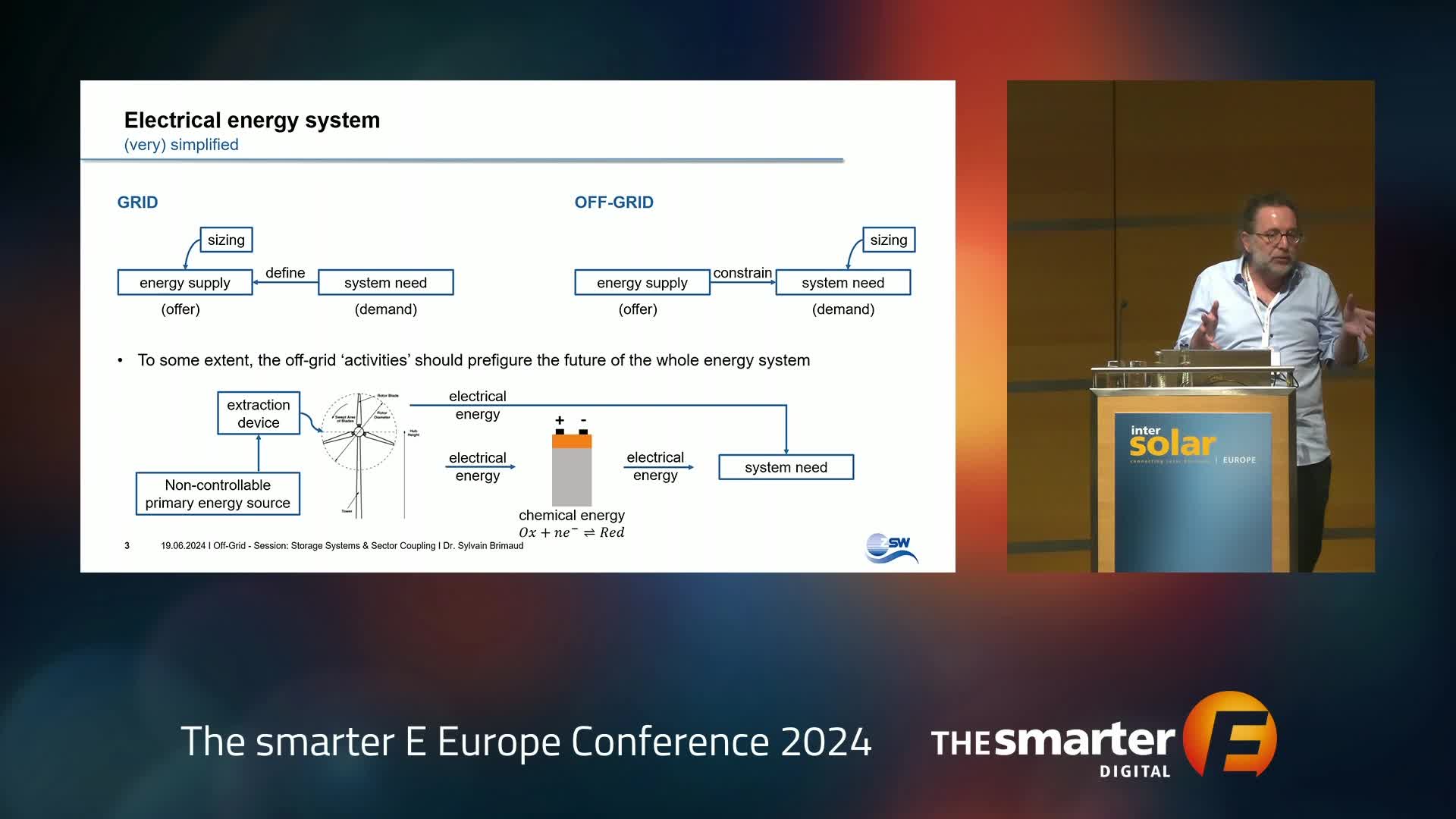
The speaker addresses the need for a shift from lithium-ion based technologies to zinc-based batteries within the stationary storage community. They argue that there are limited alternatives and outline several reasons supporting this transition. The speaker, an electrochemist affiliated with a research institute in Ulm and Stuttgart (ZSW), emphasizes their extensive experience in energy-related technologies like wind energy, photovoltaics, hydrogen fuel cells, and battery manufacturing. They highlight cost constraints associated with off-grid systems which require users to make compromises on system needs due to limits on available power. In contrast, grid-connected systems often prioritize demand over supply irrespective of cost efficiency. Moreover, they discuss the significant infrastructure needed for extracting materials required for battery production and processing them into functional components. This includes considerations of mass availability and cost-efficiency metrics such as Euros per kilowatt-hour per cycle. Specifically addressing Europe's goals regarding electric vehicles by 2035—aiming for high production targets amidst existing capacity limitations—they showcase current dependence on Asian suppliers highlighting an urgent need for expanded local manufacturing capabilities to meet future demands sustainably.

Automatisierte Zusammenfassung durch AI Conver

Dr. Sylvain Brimaud
Scientist and Team Leader
ZSW (Centre for Solar Energy and Hydrogen Research)
Germany

While solar modules are getting cheaper, storage is the key factor that determines the cost of the system. Besides new battery technologies, other forms of storage are available.

Speaker

Prof. Dipl.-Ing. Peter Adelmann
Director
id-eee Institute
Germany

To Talk

Speaker

Julius Bäurle
Electrical Engineer in System Development
Institute for Decentralized Electrification, Entrepreneurship & Education GmbH & Co. KG
Germany

To Talk

Speaker

David Gögelein
PhD Student
Technical University of Ulm
Germany

To Talk

Weiterführende Inhalte
Webinar
Growth of the European Solar Market, Specifically, Romania

February 24, 2026

Webinar: EU Solar Market Overview with Focus on Romania

The smarter E Europe Conferences 2025
Factors That Influence the Success of a Minigrid Project

Wednesday, May 07, 2025, 11:00 am - 12:30 pm

The smarter E Europe Conferences 2025 | Conference Program

Premium Account

Off-grid solar systems are often the least expensive option for rural electrification. Solar home systems can power individual households, while mini-grids can supply entire villages. Each comes with its own advantages, disadvantages, and challenges. The aim of this session is to explore challenges as well as success stories. It takes well-functioning components such as battery systems, charge management and inverters to make projects successful. Proper system sizing, maintenance and repair management, as well as a robust financial concept are also necessary. If one of these elements is missing, the electrification will not be sustainable. This session will focus on the aspects mentioned above. The speakers will present successful and unsuccessful approaches and discuss what can be learned from them.

The smarter E Europe Conferences 2025
Q&A Session of of the Session Off-Grid: Rural Electrification Based on Solar Systems - Lessons Learned

Wednesday, May 07, 2025, 11:00 am - 12:30 pm

The smarter E Europe Conferences 2025 | Conference Program

Premium Account

Off-grid solar systems are often the least expensive option for rural electrification. Solar home systems can power individual households, while mini-grids can supply entire villages. Each comes with its own advantages, disadvantages, and challenges. The aim of this session is to explore challenges as well as success stories. It takes well-functioning components such as battery systems, charge management and inverters to make projects successful. Proper system sizing, maintenance and repair management, as well as a robust financial concept are also necessary. If one of these elements is missing, the electrification will not be sustainable. This session will focus on the aspects mentioned above. The speakers will present successful and unsuccessful approaches and discuss what can be learned from them.

The smarter E Europe Conferences 2025
Setting the Scene "Affodability"

Wednesday, May 07, 2025, 04:00 pm - 05:30 pm

The smarter E Europe Conferences 2025 | Conference Program

Premium Account

Photovoltaic prices have fallen continuously in recent years - a trend that should translate into a growing market for off-grid solutions. Declining costs are crucial for rural electrification in particular, making sustainable energy supply economically viable in remote regions. However, so far many of these price advantages have not yet reached the people that need them most. Do existing framework conditions to foster rural electrification still work in this new market reality? Which measures are needed to ensure that cost reductions reach our target group? This session discusses strategies for improving the availability of low-cost off-grid solutions, financing and innovative business models. A look at successful practical examples shows which political, economic and technological levers need to be pulled to make off-grid PV accessible on a large scale.

The smarter E Europe Conferences 2025
Setting the Scene "Off-Grid"

Wednesday, May 07, 2025, 04:00 pm - 05:30 pm

The smarter E Europe Conferences 2025 | Conference Program

Premium Account

Photovoltaic prices have fallen continuously in recent years - a trend that should translate into a growing market for off-grid solutions. Declining costs are crucial for rural electrification in particular, making sustainable energy supply economically viable in remote regions. However, so far many of these price advantages have not yet reached the people that need them most. Do existing framework conditions to foster rural electrification still work in this new market reality? Which measures are needed to ensure that cost reductions reach our target group? This session discusses strategies for improving the availability of low-cost off-grid solutions, financing and innovative business models. A look at successful practical examples shows which political, economic and technological levers need to be pulled to make off-grid PV accessible on a large scale.

Sie verwenden einen veralteten Browser

Die Website kann in diesem Browser nicht angezeigt werden. Bitte öffnen Sie die Website in einem aktuellen Browser wie Edge, Chrome, Firefox oder Safari.