Recording of Tuesday, June 18, 2024 | The smarter E Europe | Conference Program | Language: English | Duration: 25:07 .
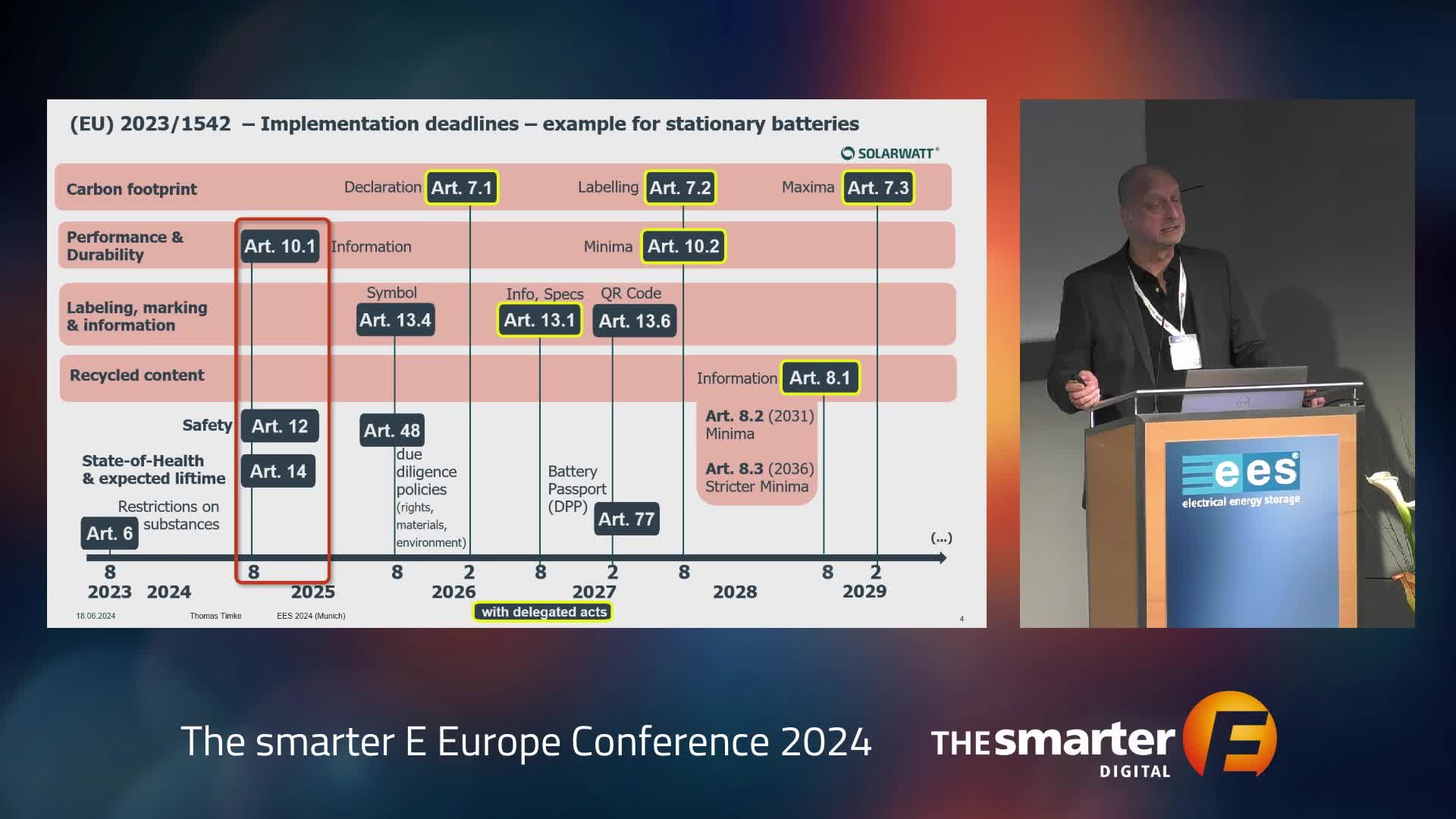
Thomas Timke from SOLARWATT discusses the complexities and challenges of standardization in battery regulation, particularly focusing on new EU regulations. SOLARWATT manufactures PV modules, lithium-ion home storage systems, and energy management systems. Thomas's role involves ensuring compliance with these standards to avoid costly mistakes in manufacturing and R&D. He highlights his involvement at various levels including serving as vice chair of the German National Committee for Secondary Batteries. The talk focuses on Articles 10, 12, and 14 of the battery regulations due to their imminent deadlines. These articles cover capacity measurement (in ampere-hours rather than watt-hours), safety requirements such as mandatory fire propagation tests which were previously voluntary except in Germany since 2014, and state-of-health reporting which will now be standardized across all systems. Despite good intentions behind these regulations aiming to set a "gold standard", they are causing confusion due to their detailed yet sometimes vague nature. The harmonized standards required by the EU Commission are not ready yet, leading manufacturers and buyers alike needing closer scrutiny during this transition period without relying solely on CE marking for conformity assurance.
Automatisierte Zusammenfassung durch AI Conver
Thomas Timke
Senior Battery Expert
SOLARWATT GmbH
Germany
The transition to a clean and CO2-neutral energy supply requires the use of components that meet these requirements. The CO2 footprint and environmental impact of battery production must be reduced to acceptable levels. With the new EU Battery Regulation, a comprehensive set of requirements has recently been published, that will have a major impact on the battery industry. What are the implications of the new EU Battery Regulation? By when must each requirement be implemented? What are the critical points of this regulation?
Further Talks of this session:
Speaker
Gunther Kellermann
Managing Director
ZVEI - German Electrical and Electronic Manufacturer Association
Germany
Speaker
Tilmann Vahle
Director, Sustainable Mobility and Batteries
Systemiq GmbH
Germany
Speaker
Dr. Nam Truong
CEO
STABL Energy GmbH
Germany