Next-Gen Battery Strategies 2027+: Potentials and Challenges for Future Battery Designs and Diversification in Product Portfolios to Serve a Large Bandwidth of Market Applications.

premium account

Recording of Wednesday, June 19, 2024 | The smarter E Europe | Conference Program | Language: English | Duration: 14:12 .

Future of Battery Technology: Industry Veteran Discusses Next-Gen Designs, Market Trends, and Cost Innovations Towards 2027 and Beyond

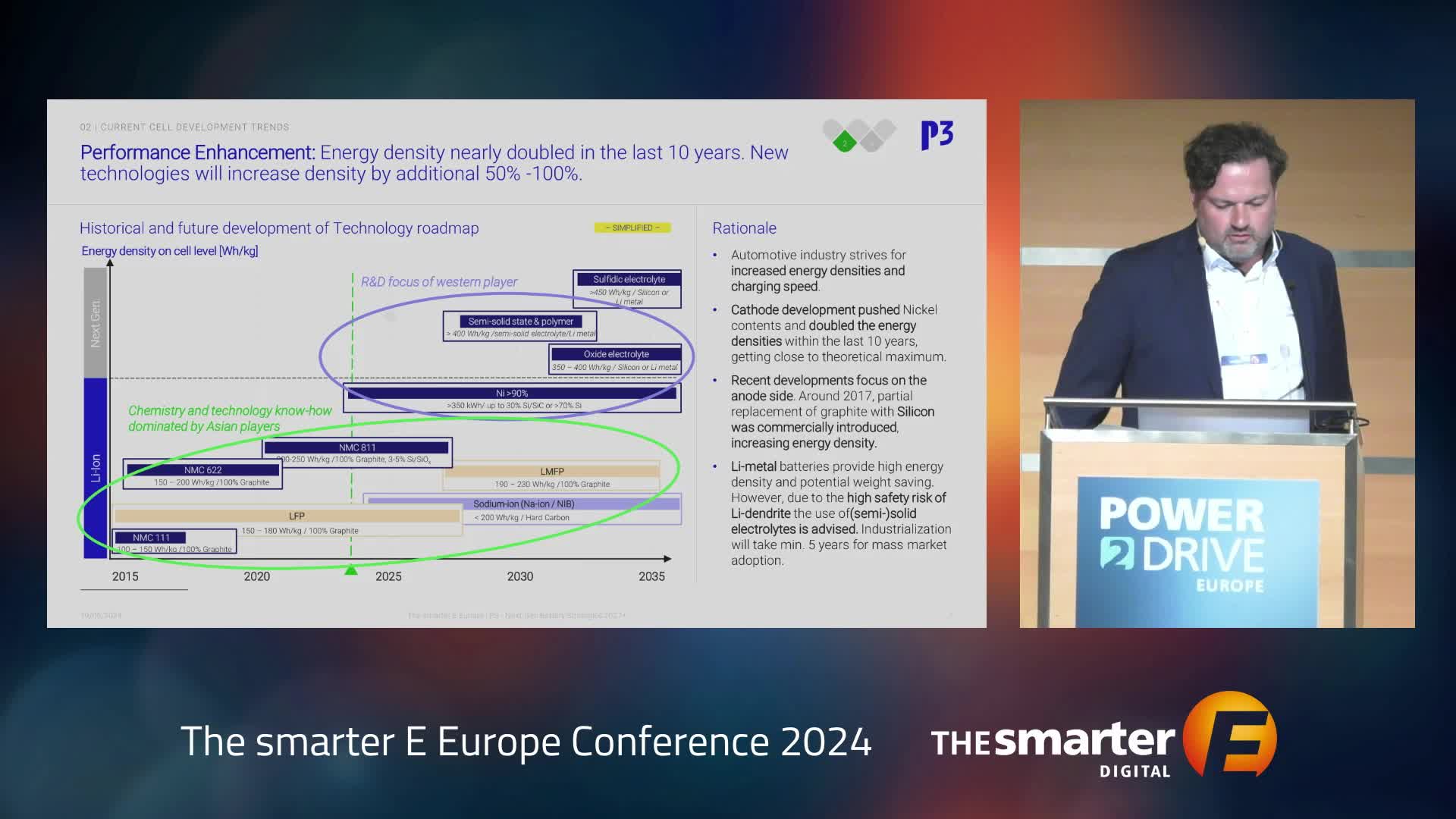
The presentation discusses the future of battery technology, focusing on developments up to 2027 and beyond. The speaker outlines key aspects such as development strategies, sales projections, next-generation battery designs, application trends, and cost implications. Starting with a historical perspective from their experience in hybridizing the Mercedes S-Class in 2006 to recent advancements like those in the Nissan Leaf by 2015, they highlight significant progress in energy density and capacity over time. Key industry players are discussed, particularly CATL's rise to dominance due to rapid innovation cycles when compared with traditional Western manufacturers. Tesla is noted as a benchmark for industrialization efficiency and cost-performance metrics within six months; its Model S, Y, and 3 showcase different batteries optimized for performance while keeping costs low. Emerging trends include blending NMC (Nickel Manganese Cobalt) with LFP (Lithium Iron Phosphate) compositions for better price-performance ratios suitable for diverse applications like automotive tracks. The supply chain remains Asia-centric despite efforts at localization by companies such as Northwell in Europe. Overall improvements are seen across energy densities rising while prices drop due to these technological innovations.

Automated summarization by AI Conver

Markus Hackmann
Managing Director
P3 Group GmbH
Germany

Batteries are at the heart of any electric vehicle. Their design determines the vehicle's range, charging speed, performance in cold weather, fire safety and many other properties. The speed of development has been immense, as new cell chemistries such as LFP, sodium-ion and solid state batteries are pushing into the market. Significant progress has been made with monitoring battery usage with a view to design optimization so that the battery performance is maximized without accelerating the ageing process. In this session, we share insights on the performance of today's vehicle batteries and future technological developments.

Further Talks of this session:

Speaker

Dr. Christopher Hecht
Data Scientist
ISEA Institute, RWTH Aachen University
Germany

To Talk

Speaker

Andreas Richter
R&D Manager
DEKRA SE

To Talk

Speaker

Dr. Jonas Böhm
TWAICE
Germany

To Talk

Speaker

Luke Hu
General Manager, Global Business
Electroder
Germany

To Talk

To Talk

Further Content
Adriana Fricke, Robin Berg
Has Vehicle-to-Grid Reached the Tipping Point?

The smarter E Podcast Episode 248 | Language: English

February 5, 2026

Why 2026 could be a turning point for bidirectional EV charging – from regulation to large V2G fleets in Europe.

Webinar Collection
Mixed Investment Solar Projects in Mexico: The 54% Model Explained

January 29, 2026

Mexico has introduced a new mixed investment scheme for renewable power generation, requiring a minimum 54% direct or indirect participation by CFE.

Irene Guerra Gil, Mark Bruno
Staying Home, with Smart Energy Management

The smarter E Podcast Episode 245 | Language: English

December 11, 2025

Irene Guerra Gil and Mark Bruno explain how smart home energy systems and building initiatives cut costs and emissions.

The smarter E Europe Exhibition Program 2025
DC Microgrids as the Next Frontier in Grid Modernization and DER Integration

Wednesday, May 07, 2025, 11:00 am - 12:25 pm

The smarter E Europe Exhibition Program 2025 | Exhibition Program

premium account

Discover how next-gen distribution grid technologies are addressing the challenges of renewable integration and dynamic energy demands. This session offers insights into the latest developments in AI-driven data analytics and the transformative role of IoT in grid management.

The smarter E Europe Conferences 2025
Factors That Influence the Success of a Minigrid Project

Wednesday, May 07, 2025, 11:00 am - 12:30 pm

The smarter E Europe Conferences 2025 | Conference Program

premium account

Off-grid solar systems are often the least expensive option for rural electrification. Solar home systems can power individual households, while mini-grids can supply entire villages. Each comes with its own advantages, disadvantages, and challenges. The aim of this session is to explore challenges as well as success stories. It takes well-functioning components such as battery systems, charge management and inverters to make projects successful. Proper system sizing, maintenance and repair management, as well as a robust financial concept are also necessary. If one of these elements is missing, the electrification will not be sustainable. This session will focus on the aspects mentioned above. The speakers will present successful and unsuccessful approaches and discuss what can be learned from them.

You are using an outdated browser

The website cannot be viewed in this browser. Please open the website in an up-to-date browser such as Edge, Chrome, Firefox, or Safari.