European Regulatory Framework for Sustainable Solar: An Update on Ecolabeling and Eco-Design of Photovoltaic Modules

premium account

Recording of Wednesday, June 19, 2024 | The smarter E Europe 2024 | Conference Program | Language: English | Duration: 14:38 .

Dr. Giorgio Bardizza Discusses Eco-Design and Energy Labeling for PV Products at Tufrainal Presentation

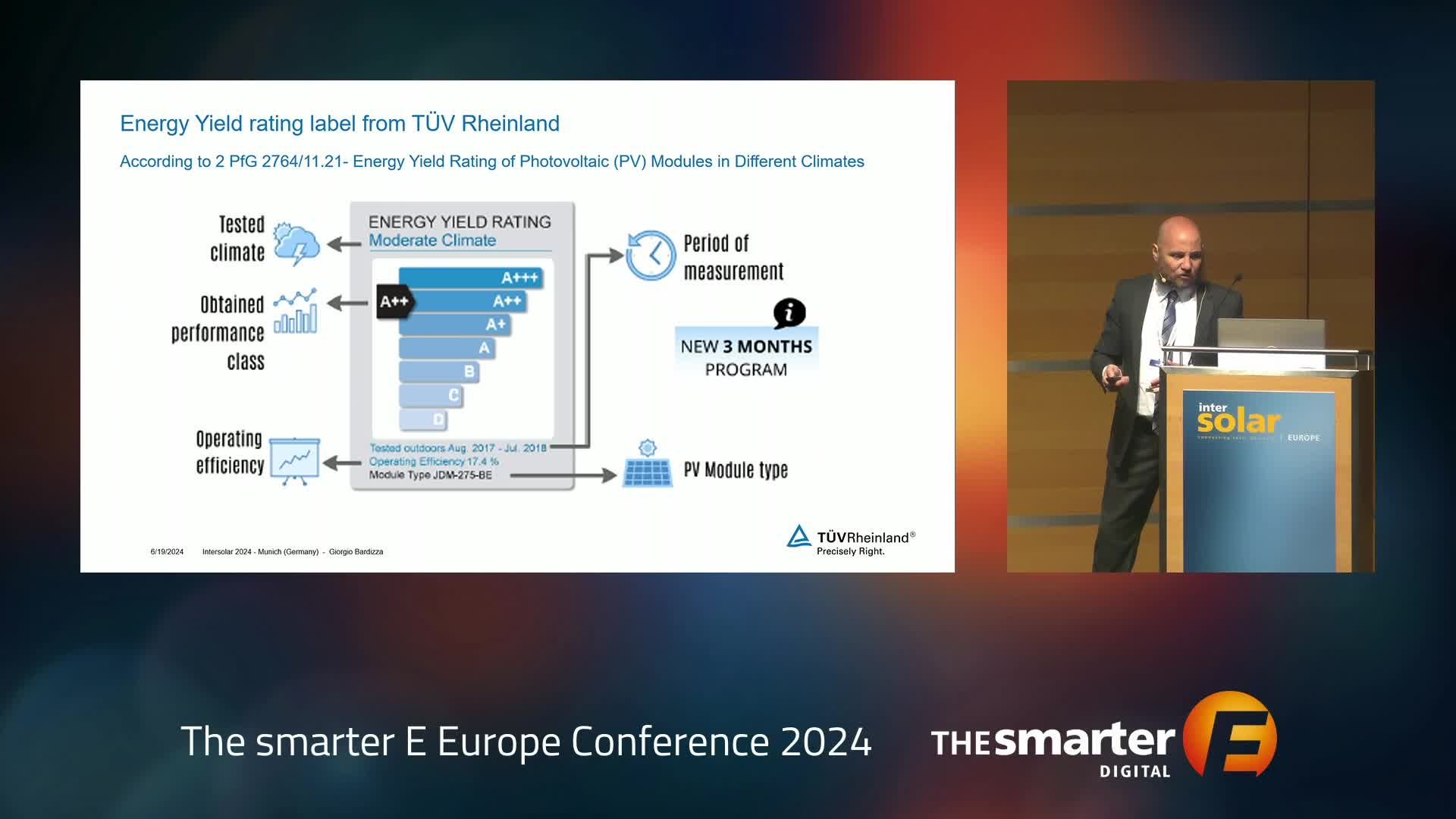
Dr. Giorgio Bardizza from TÜV Rheinland discusses the importance of eco-design and energy labels for PV products, particularly focusing on the significance of rating models based on real-world energy yield rather than standard test conditions. This approach offers a more accurate representation since standard conditions rarely occur in actual applications. TÜV Rheinland has developed its procedure to prepare such labels by performing both outdoor and indoor measurements on samples provided by clients, calculating performance ratios, and generating detailed reports. Dr. Bardizza also highlights ongoing regulatory developments within the European Commission aimed at integrating eco-design principles into PV product ratings. The proposed regulations will assess modules based on material durability, long-term degradation rates, repairability, recyclability, and manufacturing carbon footprint. There is specific focus on defining methods to measure long-term degradation effectively. The draft regulation includes default yearly degradation values for crystalline silicon (0.5%) and thin film modules (1%), with alternative methodologies requiring extensive data collection over multiple years and locations. A preliminary version of this new energy label system categorizes modules across several classes using three reference climates as described in IEC standards.

Automated summarization by AI Conver

Dr. Giorgio Bardizza
Global Manager Solar PV
TÜV Rheinland
Germany

As investors focus more on ESG criteria in the solar supply chain, the industry aims to enhance transparency, traceability, and reduce carbon footprint. This comes at a time of significant legislative change in Europe, with market access rules and the promotion of improved sustainability practices on the horizon.

This session will discuss:

  • How ESG considerations are impacting developers' procurement decisions
  • How solar manufacturers along the solar supply chain are addressing ESG concerns
  • Legislative requirements and industry efforts to increase transparency and sustainability performance
  • Processes for certifying solar products with low embodied carbon

Speaker

Dr. Guido Agostinelli
Solar Sector Head
IFC - International Finance Corporation
USA

To Talk

Speaker

Laurene Gusse
Deputy Head of Quality & Procurement
ENGIE Renewables

To Talk

Speaker

Lin Sun
Head of Sustainability Development
JinkoSolar
China

To Talk

Speaker

Alexia Ruvoletto
Head of Secretariat
The Solar Stewardship Initiative
Belgium

To Talk

Speaker

Özer Ergül
Group Head of Procurement CPO
Aquila Capital
The Netherlands

Stacy Ettinger
Senior Vice President of Supply Chain & Trade
Solar Energy Industries Association
United States

To Talk

Further Content
Webinar
Mixed Investment Solar Projects in Mexico: The 54% Model Explained

January 29, 2026

Mexico has introduced a new mixed investment scheme for renewable power generation, requiring a minimum 54% direct or indirect participation by CFE.

Anna Darmani, Principal Analyst from Wood Mackenzie
Big BESS Is Here to Save the Day

The smarter E Podcast Episode 246 | Language: English

January 8, 2026

Utility-scale batteries are booming in Europe. Discover key BESS trends, market impacts, and what to expect for large-scale storage in 2026.

The smarter E Europe Conferences 2025
Factors That Influence the Success of a Minigrid Project

Wednesday, May 07, 2025, 11:00 am - 12:30 pm

The smarter E Europe Conferences 2025 | Conference Program

premium account

Off-grid solar systems are often the least expensive option for rural electrification. Solar home systems can power individual households, while mini-grids can supply entire villages. Each comes with its own advantages, disadvantages, and challenges. The aim of this session is to explore challenges as well as success stories. It takes well-functioning components such as battery systems, charge management and inverters to make projects successful. Proper system sizing, maintenance and repair management, as well as a robust financial concept are also necessary. If one of these elements is missing, the electrification will not be sustainable. This session will focus on the aspects mentioned above. The speakers will present successful and unsuccessful approaches and discuss what can be learned from them.

The smarter E Europe Conferences 2025
Digital Tools for Planning and Monitoring: Insights from Mozambique

Wednesday, May 07, 2025, 02:00 pm - 03:30 pm

The smarter E Europe Conferences 2025 | Conference Program

premium account

This session explores how digitalization is revolutionizing off-grid energy projects, enabling scalability and efficiency in underserved areas. Experts will discuss cutting-edge solutions based on the use and application of digital tools to support planning, development, and operations ultimately enhancing affordability. Attendees will gain insights into leveraging digital tools for optimized planning and project management, customer engagement, monitoring, and sustainable growth. Real-world case studies will highlight successful implementations, showcasing how technology bridges the gap between innovation and impact in energy access.

The smarter E Europe Conferences 2025
Optimizing Island Energy Systems: Modeling Hydrogen Integration in the Asia-Pacific

Wednesday, May 07, 2025, 02:00 pm - 03:30 pm

The smarter E Europe Conferences 2025 | Conference Program

premium account

This session explores how digitalization is revolutionizing off-grid energy projects, enabling scalability and efficiency in underserved areas. Experts will discuss cutting-edge solutions based on the use and application of digital tools to support planning, development, and operations ultimately enhancing affordability. Attendees will gain insights into leveraging digital tools for optimized planning and project management, customer engagement, monitoring, and sustainable growth. Real-world case studies will highlight successful implementations, showcasing how technology bridges the gap between innovation and impact in energy access.

You are using an outdated browser

The website cannot be viewed in this browser. Please open the website in an up-to-date browser such as Edge, Chrome, Firefox, or Safari.